
When Sentimental Objects Hold More Weight Than Memory: How Items From the Past Shape Nervous-System Behavior
Clients often talk about objects they keep “because they should,” “because they always have,” or “because they feel wrong to get rid of.”
To them, these items seem harmless.
To their nervous system, they are not.
Sentimental objects often carry the emotional weight of the season in which they were acquired.
They can anchor clients to identities they are trying to outgrow.
They can shape the nervous system’s response to a room long before the client realizes what feels off.
In trauma work, somatic work, ADHD support, or any therapeutic method focused on nervous-system stability, these objects act as environmental cues.
They reinforce patterns the client may be actively working to release.
From a design perspective, the issue is not the meaning of the object.
It is the weight it holds in the room.
WHY SENTIMENTAL OBJECTS AFFECT THE NERVOUS SYSTEM
Clients often assume sentimental items create comfort.
But the body interprets objects based on the emotional imprint tied to them, not the intention behind keeping them.
Three patterns appear consistently:
1. Items connected to high-stress seasons
Even if the client is no longer in that season, the item carries the emotional tone of it.
The body recognizes it instantly.
2. Items that belonged to a former identity
Careers. Relationships. Roles. Expectations.
Clients often keep items from periods when they were functioning in ways they no longer align with.
The object becomes an environmental echo of that version of themselves.
3. Items tied to obligation, not belonging
Heirlooms. Gifts. Keepsakes.
These often remain out of duty rather than resonance.
Clients feel a subtle heaviness but cannot articulate why.
Sentimental objects frequently disrupt regulation because they cue the nervous system to remain in emotional postures tied to the past.
The client sees an item.
Their body remembers the season.
Their mind cannot explain the reaction.
THE HIDDEN COST OF “I SHOULD KEEP THIS”
Clients often hold onto sentimental objects because they believe discarding them is disrespectful or emotionally unsafe.
But living with an object that keeps them emotionally stuck comes with its own cost.
The presence of the object can create:
emotional heaviness
hesitation
discomfort they cannot name
difficulty resting
subtle vigilance
low-level sadness or irritability
These sensations do not come from the object itself.
They come from the emotional pattern attached to it.
From a therapeutic lens, this is familiar.
Clients often maintain relational patterns, habits, and beliefs simply because they existed for so long.
From a design lens, sentimental objects operate the same way.
The home becomes a physical archive of unresolved emotional seasons.
HOW THE SPACE EDIT RESET™ REVEALS THE IMPACT OF SENTIMENTAL OBJECTS
The Space Edit Reset is not about removing everything sentimental.
It is about helping clients identify what actually belongs now.
Step One: Clear Surfaces
When surfaces clear, sentimental objects that have been blending into the environment suddenly stand out.
Clients see them with clarity, not habit.
Step Two: Observe from Three Vantage Points
This is where clients notice which sentimental items create tension.
Sitting in different positions reveals the object’s influence on their emotional state.
From one angle, they may feel nothing.
From another, they feel a tightness or drop in mood they cannot deny.
Step Three: Emotional Inventory
Clients describe the item using sensory, emotional language:
“old”
“heavy”
“tired”
“out of place”
“not me anymore”
They are not talking about the object.
They are talking about the version of themselves tied to it.
Step Four: Anchor the Purpose of the Room
Once function is defined, clients often realize the sentimental object does not support the purpose of the room.
This creates permission to relocate or release it.
Step Five and Six: Reset and Confirm
These steps allow clients to choose supportive items rather than default to inherited or outdated ones.
When the object leaves the space, the nervous system shifts immediately.
REAL EXAMPLES OF HOW SENTIMENTAL OBJECTS AFFECT A ROOM
Example One: The bookshelf filled with items from a former career
A client kept awards, documents, and memorabilia from a career she had outgrown.
Even though she had moved forward professionally, the items reinforced the pressure and identity of that period.
Once she removed them, the entire room felt lighter.
She described breathing differently.
Example Two: The inherited table that dominated the dining room
A client kept a heavy wooden table passed down through generations.
It held emotional meaning, but the scale overwhelmed the space and made her feel physically crowded.
After completing the Reset, she moved it to a different part of the home and felt immediate relief.
Example Three: A box of sentimental items stored in plain sight
A client kept a box of old letters and photographs in her bedroom.
She never opened the box, yet it created emotional tension every time she walked past it.
Through the Space Edit Reset, she realized the box did not need to be visible.
Relocating it transformed how she felt in the room.
These examples are not about decluttering.
They are about nervous-system alignment.
WHY THIS MATTERS FOR THERAPISTS
Therapists often explore emotional patterns that persist long after the event, season, or relationship has ended.
Sentimental objects are the environmental equivalent of those patterns.
They can:
reinforce outdated identities
pull clients into emotional postures
trigger nervous-system responses
disrupt grounding
prevent clients from fully accessing rest
contradict therapeutic progress
When a client cannot explain why a room feels “heavy” or “off,” sentimental objects are often the reason.
Understanding the environmental role of these items gives therapists a new way to help clients make sense of their internal experience.
WHAT CLIENTS CAN DO THIS WEEK
Here are steps clients can take to evaluate the sentimental weight of a room:
1. Choose one room and identify the top three items tied to past seasons.
Simply noticing them often reveals their emotional influence.
2. Sit in three vantage points and focus on how each item affects their body.
The nervous system responds clearly once attention is directed.
3. Ask a simple question: “Does this belong in this chapter of my life?”
Clients usually know the answer instantly.
4. Relocate one sentimental item to a more appropriate space.
Relocation provides relief without requiring immediate release.
These steps help clients understand how sentimental weight affects their daily experience.
THE HOME SHOULD REFLECT WHO THEY ARE NOW
A home filled with sentimental objects may look meaningful, but it can quietly work against the nervous system.
Clients deserve environments that match their current life, not the chapters they survived.
When sentimental objects no longer dominate the room:
posture changes
breath expands
rest becomes easier
emotional clarity increases
focus improves
the room begins to feel like a true match for their identity
The Space Edit Reset™ gives clients a structured, non-overwhelming way to create homes that support who they are becoming, not who they used to be.
Is their space working for them or against them?
Are your clients ready for the Space Edit Reset? CLICK HERE>>>
The Hidden Impact of Furniture Placement on Nervous-System Load
Clients often talk about feeling tense, distracted, or unsettled in their home, even when the space is clean and well decorated. They assume this discomfort is emotional, circumstantial, or related to stress. But there is another influence almost no one considers:
Furniture placement is constantly shaping their nervous system.
The body reads furniture the same way it reads people.
It responds to angles, compression, openness, obstacles, and pathways.
It registers whether a room is easy to move through or demands micro-adjustments.
It senses how each piece of furniture affects posture, orientation, and visual load.
From a design perspective, furniture is not just décor.
It is architecture that communicates with the nervous system every second a client lives in the space.
This is why therapists notice patterns their clients cannot explain.
Clients describe feeling “on edge,” “unsettled,” or “wired” in certain rooms.
The nervous system is responding to the way the body must navigate the room.
Furniture placement can either support regulation or disrupt it.
WHY THE BODY CARES ABOUT FURNITURE MORE THAN THE MIND DOES
Clients assume furniture is neutral. They think it is only about taste or style. But the body interprets furniture through a very different lens:
1. Does this layout allow ease of movement?
If a pathway forces the client to twist, sidestep, or slow down, the system interprets this as resistance.
2. Does the room require frequent micro-adjustments?
Narrow walkways, poorly placed tables, and oversized pieces increase cognitive load without clients realizing it.
3. Does the seating support natural posture?
A sofa that is too deep or too low compresses the torso and limits breath.
A chair that angles toward a walkway keeps the body oriented toward potential interruption.
4. Does the room provide visual clarity or visual competition?
Placement affects sightlines, which affect nervous-system steadiness.
5. Does the body feel compressed, crowded, or exposed?
The system picks up on proportional imbalance instantly.
These reactions happen before conscious thought.
Therapists recognize the somatic cues.
Designers see how the space produces them.
THE THREE MOST COMMON WAYS PLACEMENT CREATES NERVOUS-SYSTEM STRAIN
1. Pathways that compress movement
Rooms with too many furniture pieces or awkward placements create pathways that force the client to adjust constantly.
Every adjustment is a cue of instability.
Clients describe it as irritation, tension, or unease.
2. Furniture scale that overwhelms the architecture
Oversized sofas, large chairs, and heavy coffee tables create visual and physical pressure.
Clients feel crowded even when the room is technically clean.
3. Seating directed toward high-stimulus zones
Clients unknowingly position seats toward:
doorways
hallways
traffic paths
screens
busy surfaces
The eyes pick up movement and detail long before the client notices.
This keeps the system slightly alert.
From a therapeutic perspective, these are somatic triggers.
From a design perspective, these are architectural cues.
HOW THE SPACE EDIT RESET™ ACTUALLY FIXES PLACEMENT ISSUES
Placement is not the first step in the Space Edit Reset.
It is the result of observing the room with clarity.
Clients who skip straight to rearranging often recreate the same dysfunction.
The Reset builds placement logically:
Step One: Clear Surfaces
This removes the visual noise that hides placement problems.
Step Two: Observe from Three Vantage Points
This reveals how the current layout affects posture, movement, and nervous-system signals.
Clients notice:
which angles feel compressed
which corners feel exposed
where they brace without realizing
which line of sight feels chaotic
which seat feels safe but stagnant
Step Three: Emotional Inventory
Here, clients describe how their body reacts to the layout.
The language becomes precise once the room is seen without distraction.
“Tight.”
“Off balance.”
“Crowded.”
“Stuck.”
Step Four: Anchor
The room’s purpose is defined.
Function determines where key furniture pieces must go.
This step alone eliminates 50 percent of layout mistakes.
Step Five: Reset
The room is rebuilt around function rather than habit or decoration.
Placement becomes supportive, not performative.
Step Six: Confirm
Clients feel the physical difference immediately.
Movement becomes smoother.
Posture opens.
Breath deepens.
Attention settles.
The room now works with the body instead of against it.
REAL EXAMPLES OF FURNITURE PLACEMENT SHAPING THE NERVOUS SYSTEM
Example One: The sofa blocking circulation
A client placed her sofa directly in the natural walkway. Every time she entered the room, she squeezed past it.
She described feeling annoyed at home and did not know why.
The Reset revealed that the sofa forced her body into micro-agitation dozens of times a day.
After resetting the layout, her entire emotional baseline shifted.
Example Two: The reading chair facing a busy sightline
A client complained she “couldn’t relax to read.”
Her chair faced her kitchen counters, which held multiple categories and constant visual tasks.
The body stayed alert because the sightline was a stream of micro-responsibilities.
Once she reoriented the chair, she finally felt settled.
Example Three: The dining table that dominated the room
A client bought a trendy oversized table. It photographed beautifully but overwhelmed the space.
She felt crowded during meals.
She felt rushed in the morning.
She felt drained before sitting down.
Her system was responding to proportional imbalance.
The Reset reduced visual pressure, and the client described an immediate shift in mood and clarity.
These examples show how placement influences physiology more strongly than décor ever will.
WHY THIS MATTERS FOR THERAPISTS
Furniture placement reflects and reinforces nervous-system patterns.
When clients struggle with:
hypervigilance
dysregulation
overwhelm
chronic tension
irritability
fatigue
…the room often contains environmental cues that mirror those states.
Therapists see the internal pattern.
Designers see the external pattern.
The client needs both.
Placement issues are not aesthetic problems.
They are nervous-system problems.
When the environment stops reinforcing tension, clients experience more:
predictability
steadiness
rest
clarity
capacity
emotional tolerance
Placement is not just a design choice.
It is a physiological influence.
WHAT CLIENTS CAN DO THIS WEEK
Here are practical steps that align with therapeutic goals:
1. Walk the primary pathways and observe where the body tightens.
This reveals the major placement-related stress points.
2. Sit in three different seats and note posture changes.
The seat that consistently collapses or compresses the body identifies a layout issue.
3. Remove one oversized item and notice the shift.
Large pieces often create the majority of visual pressure.
4. Photograph the room and look for areas of crowding.
Photos expose imbalances that eyes ignore.
These steps help clients see their environment with accuracy instead of habit.
THE HOME AS A SUPPORT SYSTEM, NOT A STRESS SOURCE
Furniture placement determines how the body moves, rests, breathes, and reacts.
A room can reinforce dysregulation.
A room can reinforce steadiness.
A room can keep clients stuck in patterns they are trying to leave behind.
The Space Edit Reset™ gives them structure to build rooms that support their nervous system — rooms that make regulation easier instead of harder.
Is their space working for them or against them?
Why a “Perfectly Styled” Home Can Still Create Internal Chaos
Your clients scroll social media, see immaculate homes, and think they know exactly what theirs should look like. They recreate the look. They choose the right furniture. They match colors, hang artwork, arrange pillows, and lay out a room that photographs beautifully.
Then they sit down to relax and feel everything but calm.
The room is clean.
The décor is coordinated.
Nothing is out of place.
Yet something feels chaotic.
The nervous system does not care that the room looks perfect.
It cares how the room functions.
This is the missing piece most design content ignores and therapists instantly recognize: a room can be aesthetically flawless and still work against the body.
THE DIFFERENCE BETWEEN “STYLE” AND “STABILITY”
Style follows trends.
Stability follows the nervous system.
Clients often design their homes based on visual inspiration rather than how a space actually performs. The result is a mismatch between appearance and experience.
Consider these common patterns:
Pattern One: Aesthetic decisions that ignore circulation
A client centers a large rug under the sofa because it looks great in a photo, but the placement narrows every walkway in the room. Each time they move through the space, their body adjusts. Over time, the micro-tension becomes emotional tension.
Pattern Two: Décor layers that overwhelm the eye
Trend-forward homes often layer decorative items: trays, vases, sculptures, stacked books, textiles, candles. These items look intentional, but when grouped together they create visual weight the body must constantly process.
Pattern Three: Furnishings chosen for images rather than for physiology
A stunning sofa chosen for its style might be too deep or too low. Clients sink into it and instantly lose postural support. Their breath changes. Their attention scatters. They blame stress. The real issue is architecture.
Style does not tell the body how to feel.
Function does.
WHY THIS HAPPENS SO OFTEN
Clients mistakenly believe that a beautiful space equals a supportive space.
They try to follow what they see online.
But social media homes are designed for photographs, not for nervous-system alignment.
Styled spaces often include:
bold contrast
high object count
multiple visual focal points
strong lines and angles
exaggerated symmetry
decorative complexity
These features perform well in pictures.
But for clients who are sensitive, overwhelmed, recovering, or simply functioning like most modern adults, they create strain.
A room designed for aesthetics may feel like a performance, not like support.
THE NERVOUS SYSTEM DOES NOT READ BEAUTY. IT READS LOAD.
The body evaluates a room based on:
how many decisions it must make
how many objects it must categorize
how evenly space is distributed
how much visual weight sits in the field of view
how the furniture influences posture
how many micro-adjustments movement requires
how predictable or unpredictable the environment feels
A “perfectly styled” home can overwhelm because it demands more processing per second than the client realizes.
Clean does not equal calm.
Pretty does not equal stable.
Styled does not equal supportive.
THE SPACE EDIT RESET™ CLARIFIES THE DIFFERENCE
The Reset reveals what the eye has been missing and what the body has been trying to communicate.
Step One: Clear Surfaces
This removes the decorative noise layered into the space. Many clients feel relief before they move anything else. They finally see the room’s architecture without distractions.
Step Two: Observe from Three Vantage Points
This is where the truth becomes unavoidable.
From one spot, the room might look gorgeous.
From another, it feels chaotic.
Clients see:
the crowded bookshelf that looked “styled”
the oversized coffee table that compresses circulation
the decorative items that create visual static
the mismatched heights that pull the eyes in multiple directions
the rug placement that alters posture
They suddenly understand why the room feels busier than it looks.
Step Three: Emotional Inventory
Clients describe their beautifully styled rooms using words they never expect:
“loud”
“sharp”
“tight”
“busy”
“wired”
These terms are not about aesthetics.
They are about nervous-system interpretation.
The Room Reset clarifies whether the décor is enhancing the space or competing with it.
Steps Four through Six: Anchor, Reset, Elevate, Confirm
These steps turn the room into an ally.
They establish function, reduce friction, and build an environment that supports the client’s internal state rather than undermining it.
A space can be both beautiful and regulating.
But beauty without structure creates chaos.
REAL EXAMPLES OF BEAUTIFUL ROOMS THAT FELT TERRIBLE
Example One: The picture-perfect living room that created anxiety
A client styled her living room like a magazine. Neutral palette. Modern shapes. Intentional décor. The problem was the object density. Every surface held something decorative.
When she went through the Reset, she realized her eyes never rested. The room was visually crisp but psychologically demanding.
Example Two: The bedroom designed from Pinterest boards
A client chose a wall of artwork that she saw online. It looked curated and elegant. Yet she described feeling restless every night.
Through the Reset, she learned the artwork created multiple focal points directly across from her bed. Her system stayed alert because the visual field was too active.
Example Three: The dining room chosen for aesthetic impact
Another client followed a trend of large, sculptural centerpieces and oversized chairs. The look was stylish. But the chairs were heavy and difficult to move, making everyday use physically stressful.
The room impressed others but irritated her nervous system.
These patterns repeat across homes regardless of price point.
The issue is not taste.
The issue is function.
WHY THERAPISTS SHOULD CARE ABOUT THIS
Your clients practice regulation, grounding, and emotional resilience.
But when they go home to a space designed for appearance rather than experience, their progress becomes inconsistent.
A styled-but-strained room can:
increase emotional load
disrupt regulation
amplify overwhelm
trigger irritability
decrease tolerance
limit rest
mimic anxiety symptoms
Therapists see emotional patterns.
Designers see environmental patterns.
Both matter equally.
If the environment contradicts the client’s internal work, the home quietly unravels the stability they are trying to build.
WHAT CLIENTS CAN DO THIS WEEK TO REDUCE STYLED CHAOS
Here are simple, powerful steps that bridge design and nervous-system alignment:
1. Remove half of the decorative items from one surface.
Most styled spaces contain twice the number of objects needed.
2. Sit in three different vantage points and ask, “Where does my eye stop?”
If the eye never stops, the nervous system cannot settle.
3. Identify one decorative element that adds visual weight without adding function.
This usually becomes the item that creates internal chaos.
4. Photograph the room before and after clearing a single area.
Clients often see more imbalance in photos than in real life.
These steps help clients understand the difference between a space that looks good and a space that works well.
THE FUTURE OF DESIGN IS NERVOUS-SYSTEM LED
As clients become more self-aware, the old design metric — “Does it look good?” — is losing relevance.
The real question is:
Does the space support the person who lives there?
A beautiful room can feel terrible.
A simple room can feel incredible.
The difference is not style.
It is performance.
The Space Edit Reset™ gives clients the structure to build rooms that meet both needs: visually strong and physiologically supportive.
A home can be stunning and stabilizing.
But not if beauty is the only goal.
Is their space working for them or against them?
The Science of Visual Noise: Why a Clean Home Can Still Dysregulate the Nervous System
Therapists hear versions of this every day:
“My house is clean, but I still feel overwhelmed.”
“I put everything away, yet something still feels off.”
“I can’t figure out why this room makes me tense.”
Clients assume a space feels chaotic because it is messy. But from a design perspective, a room can be spotless and still create nervous-system strain. The issue is not clutter. The issue is visual noise — the constant stream of information the eyes must process even in a clean, decorated home.
The nervous system scans a room in less than a second.
It registers object density, contrast, height variation, material shifts, and circulation patterns long before the client consciously notices anything.
If the room sends too many signals at once, the system reacts just as strongly as it would in a visibly cluttered environment.
This is the hidden reason many clients feel activated in spaces that “should” feel calm.
Their home is visually loaded even when it is clean.
The Space Edit Reset™ reduces this load through structured environmental alignment. Therapists who understand visual noise can better help clients connect the dots between internal symptoms and external conditions.
WHAT EXACTLY IS VISUAL NOISE?
Visual noise is the accumulation of micro-stimuli in a room that demand processing.
Even if a client is not consciously looking at these details, their body is responding to them.
Visual noise includes:
too many small objects across surfaces
décor items with competing textures
open shelves filled with categories
furniture with strong vertical or horizontal lines
crowded art walls
busy patterns
overly bright or uneven lighting
mismatched scale
excessive visual contrast
Each element is harmless on its own.
Together, they create a landscape the nervous system experiences as fragmented.
A client’s eyes bounce from item to item without a place to rest. Their brain tries to organize what it sees. Their system works harder to filter out irrelevant data. This keeps them in low-level activation without ever identifying the cause.
Visual noise does not look chaotic.
It feels chaotic.
WHY CLEAN DOES NOT MEAN CALM
Clients often confuse cleanliness with stability.
They believe that if the home is orderly, they should feel grounded.
But the nervous system does not read “clean.”
It reads:
proportion
density
scale
rhythm
organization of height
sequencing of surfaces
distribution of objects
circulation paths
A room can be immaculately cleaned and still contain:
visual intensity
sensory overload
scattered focal points
abrupt transitions
architectural imbalance
Even well-styled homes can undermine regulation if the room lacks visual rest.
The nervous system wants coherence, not décor.
This is why some clients relax more in minimal hotel rooms than in their own beautifully decorated homes. The environment is simpler, clearer, and easier to process.
Homeowners often assume they need new décor to feel better.
In reality, they need fewer visual interruptions.
HOW VISUAL NOISE TRIGGERS THE NERVOUS SYSTEM
Visual noise impacts the body in three predictable ways:
1. It increases cognitive load.
Every object becomes a micro-task.
Every variation becomes a cue.
The mind tracks categories without realizing it.
2. It interrupts focus and rest.
The eyes cannot settle.
The system stays slightly alert.
Clients feel restless in rooms that overwhelm their visual field.
3. It creates emotional fatigue.
The body grows tired from constant processing.
Clients often describe this as “anguish,” “tension,” or “heaviness,” even when the room is spotless.
Therapists misattribute this sensation to emotional dysregulation.
Clients blame themselves for feeling stressed in a clean home.
But the cause is architectural.
THE SPACE EDIT RESET™ CLARIFIES WHAT THE NERVOUS SYSTEM HAS BEEN TRYING TO SAY
The Reset breaks visual noise into observable patterns.
Step One: Clear Surfaces
This step reveals the true architecture of the room.
When surfaces are clear, the nervous system stops scanning dozens of objects simultaneously. Clients feel relief within minutes.
Step Two: Observe from Three Vantage Points
This is where visual noise becomes undeniable.
From one seat, the room may look calm.
From another, everything feels loud.
Clients notice:
tall items that create visual pressure
clusters of small décor
abrupt transitions between furniture pieces
a crowded shelf they forgot about
the uncomfortable density of a particular corner
They finally understand why the room feels busier than it looks.
Step Three: Emotional Inventory
Clients describe the room’s visual noise in sensory terms:
“static”
“tight”
“busy”
“uneven”
“jumbled”
“sharp”
These descriptions reflect the body’s interpretation of the space.
The Reset gives them language for sensations that previously felt vague.
Steps Four through Six: Alignment
These steps help clients reduce unnecessary stimuli and create visual structure that supports regulation.
The result:
The nervous system stops working overtime.
The room becomes coherent.
The body relaxes naturally.
WHAT VISUAL NOISE LOOKS LIKE IN REAL HOMES
Here are real examples that therapists will instantly recognize in their clients:
Example One: A spotless kitchen that felt chaotic
A client kept her countertops clean but stored multiple categories in open view. Coffee supplies. Supplements. Mail. Small appliances. The surface was clear, but the visual field was crowded.
Once she cleared everything except one functional zone, she described the kitchen as “quiet” for the first time.
Example Two: A living room filled with décor that made the space visually “loud”
A client’s living room had shelves decorated with varied objects, each intentional and beautiful. Yet her system responded with agitation. Too many visual categories created a sense of noise even though everything was styled.
When she simplified the shelves, her body eased immediately.
Example Three: A bedroom with competing focal points
A client struggled to fall asleep even in a clean room. The problem was not clutter. It was visual intensity. The artwork, lamps, pillows, and decorative items pulled the eye in five directions.
Once the Reset clarified the architecture, she removed two focal points and felt the room settle.
The nervous system responds to architecture, not aesthetics.
WHY THIS MATTERS FOR THERAPISTS
Therapists often see clients progress in session only to lose momentum at home.
Visual noise is one of the most common reasons why.
A visually noisy room:
accelerates overwhelm
disrupts regulation
lowers tolerance
increases irritability
reduces emotional capacity
keeps the system in readiness mode
Clients try to regulate in environments that contradict the state they’re practicing.
The room keeps training the system in ways the client cannot identify.
They assume they’re failing the technique.
In reality, the environment is failing them.
Understanding visual noise gives therapists a missing link between environmental stress and emotional patterns.
WHAT CLIENTS CAN DO THIS WEEK
Here are steps that produce immediate impact:
1. Clear the busiest surface in the room that feels the most overwhelming.
This reduces instant load.
2. Sit in three vantage points and list the items the eyes land on first.
These are the true sources of visual noise.
3. Remove three small décor items that create unnecessary contrast.
This simplifies the visual field.
4. Photograph the room from all corners.
Photos reveal noise clients never see in real time.
These steps lower the environmental volume so the body can settle.
THE HOME AS AN ENVIRONMENTAL INTERVENTION
Visual noise is not a matter of taste.
It is a nervous-system factor.
When clients live in a visually coherent environment:
their stress responses decrease
focus improves
rest becomes more restorative
emotional patterns stabilize
therapeutic skills integrate more consistently
When visual noise dominates the home, clients feel as if they are constantly “behind,” even in a clean space.
The Space Edit Reset™ gives them the structure to reduce visual noise, restore coherence, and create rooms that work for their nervous system rather than against it.
Is their space working for them or against them?
Why Rooms Hold Emotional Residue: The Environmental Patterns Your Clients Feel but Can’t Explain
Clients often describe walking into a room and feeling something shift inside them. Their posture tightens. Their breath changes. Their awareness sharpens. The sensation is immediate and specific, yet they cannot explain it. The room looks clean. The décor is fine. Nothing dramatic happened there recently.
Still, the space carries weight.
Therapists hear this constantly. Clients say a room feels tense, heavy, unsettled, or “not like me anymore.” They assume these reactions come from internal states. But from a design perspective, the environment itself is holding emotional residue the body recognizes immediately.
Rooms remember.
Not the way people remember, but through arrangement, density, posture, and visual cues.
The environment keeps traces of past seasons long after the client has moved forward.
The Space Edit Reset™ identifies these traces, reveals the environmental patterns behind them, and gives clients a way to release the weight their home has been carrying.
THE STRANGE WAY ROOMS HOLD MEMORY
A room often reflects the emotional tone of the season in which it was created.
Clients decorate, arrange, and use spaces while living through:
stress
loss
transitions
survival periods
identity shifts
relational tension
burnout
Those experiences become embedded in the physical layout, not through mystical means, but through design logic.
1. Survival seasons create crowded surfaces
During hard times, clients place things where they need them, not where they belong. The result is a visual map of everything they were carrying.
2. High-stress seasons create functional shortcuts
Furniture gets pushed into corners, items pile on nightstands, and tasks are left visible “so I don’t forget.” The body remembers the urgency tied to these choices.
3. Grief seasons freeze a room in place
Clients hold onto objects that belonged to a former life chapter. The room becomes a museum of emotional placeholders.
4. Major transitions leave the environment mismatched
Career shifts, moves, breakups, and identity changes create misalignment. The room continues representing a version of the client who no longer exists.
These patterns sit silently in the home long after the emotions soften.
The nervous system reads them instantly.
The body recognizes the imprint before the mind notices the room.
This is what emotional residue looks like from a design perspective.
WHY CLIENTS FEEL EMOTIONAL RESIDUE BEFORE THEY SEE IT
The nervous system gathers environmental data faster than conscious awareness.
Clients sense:
imbalance in the architecture
crowding along the edges
visual noise across surfaces
outdated objects that signal a previous identity
posture patterns reinforced by furniture scale
areas of the room that “feel stuck”
These cues create physiological responses:
tight shoulders
shallow breath
distraction
low-level irritability
avoidance
fatigue
Clients often assume they are “in a mood.”
But the room is triggering a pattern the body remembers.
The mind tries to make sense of the sensation.
The body already knows the cause.
THE SPACE EDIT RESET™ AS A TOOL FOR RELEASING RESIDUE
The Reset does not treat emotional residue as an abstract concept. It treats it as an environmental pattern.
Clients begin with clearing surfaces.
This removes the layer of visual noise that hides the architecture beneath.
Often, the moment the surfaces clear, clients feel the first release.
Next, clients sit in three vantage points.
This step reveals where the emotional residue is strongest.
Certain angles feel heavier, tighter, or more compressed.
Clients describe sensations that match what they have been holding internally:
“This spot feels old.”
“This corner makes me tense.”
“This side feels like who I used to be.”
These reactions are somatic truths about the environment.
Then the emotional inventory step clarifies why.
Clients identify which items carry emotional weight.
They recognize objects that represent former roles, relationships, or expectations.
They see how the room holds pieces of their past they do not want to bring into their present.
This is not decluttering.
This is alignment.
It is releasing the version of themselves the room has been trapping.
REAL EXAMPLES OF EMOTIONAL RESIDUE INSIDE ROOMS
These examples demonstrate how emotional residue appears through architecture, not through sentiment.
Example One: A bedroom that carried exhaustion
A client kept describing her bedroom as “heavy,” even though it was orderly. When she went through the Reset, she realized the arrangement matched a period when she was caring for aging parents. The nightstands held items from that season. The layout was designed around fatigue, not restoration.
When she cleared the surfaces and reassessed what belonged, the room finally felt like a place for her current life, not the version of her that lived in constant duty.
Example Two: A kitchen shaped by conflict
A client felt uneasy every time she stood in her kitchen. Through the Reset, she noticed the table placement mirrored the dynamics of a stressful work year when she took most calls at the kitchen island. The space held the tension of that period.
A small shift in the layout changed the entire emotional tone.
Example Three: A living room arranged around loss
A client lived for years with a layout created during a difficult grieving process. Surfaces held items tied to memories she did not realize were influencing her daily experience. Once she identified which pieces represented emotional residue, she felt immediate lightness in the room even before making decorative changes.
The environment had been holding the grief long after she stopped feeling it daily.
WHY EMOTIONAL RESIDUE MATTERS IN THERAPY
Therapists see the internal version of this phenomenon: clients adopt postures, beliefs, and responses shaped by past experiences.
Rooms do the same thing externally.
When emotional residue remains in the home:
clients feel stalled
progress feels inconsistent
the past feels closer than it really is
energy feels drained quickly
emotional triggers appear without clear cause
Many clients think they are regressing.
In reality, their home is reinforcing patterns they no longer identify with.
A room can support the client’s growth.
A room can stall it.
A room can subtly work against the nervous system.
A room can expand the client’s capacity.
Without environmental alignment, clients live inside the emotional artifacts they are trying to outgrow.
WHAT CLIENTS CAN DO THIS WEEK
Here are structured steps clients can take to begin releasing emotional residue:
1. Clear one major surface in the room that feels the heaviest.
This reveals the true architecture beneath the emotional layer.
2. Sit in three vantage points and write down three words for each.
The descriptors usually reveal emotional patterns hidden in the room.
3. Identify one object that represents a former season of life.
Removing or relocating it creates immediate release.
4. Photograph the room before and after.
Clients often discover the emotional residue more clearly in the images.
These steps create clarity, not chaos.
They reduce overwhelm and help the home reflect the client’s current identity.
THE HOME AS PART OF THE HEALING PROCESS
Emotional residue is not a flaw in the client.
It is an imprint in the environment.
When the room reflects who they are now, the body responds:
the breath expands
the posture settles
avoidance patterns disappear
rest becomes easier
clarity increases
emotional capacity grows
The Space Edit Reset™ gives clients the structure to release what their home has been carrying for them.
When the environment no longer traps the past, the client has more space to build the future they are working toward.
Is their space working for them or against them?
When a Room Trains the Nervous System: The Environmental Patterns Your Clients Can’t Override
Therapists often work with clients who understand regulation techniques but struggle to apply them in daily life. They practice grounding in your office, feel steady during sessions, and describe moments of clarity. Then they return home and everything unravels.
Nothing “bad” happens at home.
No conflict.
No crisis.
No triggering conversation.
Yet something in their body shifts the moment they walk into certain rooms.
From a design perspective, this pattern is predictable.
The room is training the nervous system just as much as any habit, routine, or posture.
This concept aligns closely with Irene Lyon’s teaching: the body responds to cues long before the mind labels them. A home full of conflicting signals, outdated patterns, or structural friction alters how the system behaves.
The client is not failing their regulation tools.
Their environment is running a program the body has learned to follow.
THE ROOM AS A SOMATIC TEACHER
Clients interpret their environment somatically, not intellectually.
Before they think, they sense.
Before they decide, they react.
When I walk through a home, I watch clients respond to the room the way a body responds to an old story:
a narrowed hallway tightens their shoulders
a crowded surface increases cognitive load
mismatched seating height compresses their torso
furniture that blocks circulation creates micro-bracing
a dark corner sends subtle signals to stay alert
These reactions happen instantly.
No one chooses them.
The room cues them.
This is why clients often feel unease, agitation, or low-level tension even in “nice” rooms. The body recognizes what the mind overlooks.
A room becomes a somatic teacher.
It shapes breath, posture, readiness, orientation, and attention.
For clients doing regulation work, this creates a mismatch. Their body practices one state in therapy and another state at home.
THE THREE ENVIRONMENTAL PATTERNS THAT DERAIL REGULATION
Across hundreds of homes, I see the same categories of environmental stress that align with nervous-system behavior:
1. Spaces designed for former survival modes
Clients often arrange rooms during a stressful season of life, then never update them.
The environment continues to reflect:
hypervigilance
burnout
depletion
urgency
emotional compression
Even when the client has healed internally, the room keeps holding the posture of their past experience.
2. Visual environments that demand constant micro-processing
Clients try to regulate while sitting in rooms filled with:
object clusters
scattered categories
mixed heights
busy décor
open storage
The nervous system interprets these details as tasks.
Regulation cannot coexist with constant scanning.
3. Physical layouts that compromise breath and posture
Furniture scale and placement determine how the body organizes itself.
Rooms that work against natural posture lead to:
collapsed ribcage
restricted breath
forward-leaning vigilance
compressed diaphragm
tension across the neck and shoulders
Clients attempt to regulate while sitting in positions that contradict the state they are trying to achieve.
This is not lack of skill.
This is environmental contradiction.
THE SPACE EDIT RESET™ AS A SOMATIC ALIGNMENT TOOL
The Space Edit Reset™ system intersects perfectly with somatic work because it begins with the first principle of regulation:
See what is happening before taking action.
The Reset starts with clearing surfaces to reduce visual noise.
This step is less about aesthetics and more about removing the interference that keeps the body in a reactive state.
When clients remove the excess and observe the architecture beneath, their system receives a cleaner, quieter field of information.
Next, clients sit in three vantage points.
This is the somatic breakthrough.
They notice what their body has been responding to subconsciously:
imbalance
compression
crowding
outdated emotional markers
visually demanding corners
circulation patterns that keep them ready to move
Each seat reveals a different environmental truth.
Clients often describe these realizations in physical terms:
“This corner feels tight.”
“My chest feels low here.”
“My shoulders lift when I face that wall.”
“This side feels calmer.”
They are not talking about décor.
They are talking about the body.
The Reset gives them structure so these reactions finally make sense.
REAL EXAMPLES OF HOW ROOMS TRAIN THE BODY
Example One: The living room that cued readiness
A client practiced grounding techniques daily but reported feeling “keyed up” every time she entered her living room. When she went through the Reset steps, she noticed her sofa faced a walkway with frequent movement. Her body stayed in orientation mode without her realizing it.
By shifting her seating angle and clearing the nearest surface, her system stopped preparing for interruption.
Example Two: The bedroom arranged for vigilance
Another client described waking up tired despite sleeping in a neat, calm room. Through the Reset, she discovered her bed faced a tall, crowded dresser that created a sense of looming pressure. The body interpreted the vertical weight as a cue to stay alert.
After clearing the surface and shifting the dresser’s position slightly, the room felt noticeably lighter.
Example Three: The home office that compressed posture
A client’s desk was pushed into a corner with shelves on both sides. The visual density made the space feel narrow, and her shoulders lifted every time she sat down. She believed the problem was work stress.
The Reset revealed the environment itself was inducing micro-bracing. Once she opened the sightlines and cleared one shelf, her posture changed naturally.
These examples are not emotional.
They are architectural.
The environment was training the nervous system in specific directions.
WHY SOMATIC WORK NEEDS ENVIRONMENTAL ALIGNMENT
Clients can regulate in your office because the space supports the state they are practicing.
But their home may be teaching their body the opposite:
urgency
alertness
fragmentation
indecision
compression
Somatic work relies on repetition and consistency.
The home must reinforce the desired state, not undo it.
When environment aligns with somatic principles:
the body shifts faster
grounding becomes predictable
stress responses decline
routines stabilize
emotional load decreases
clients feel more capable
When environment contradicts somatic principles:
clients regress between sessions
grounding becomes inconsistent
focus collapses quickly
repetitive patterns return
clients blame themselves
But the cause is architectural, not personal.
WHAT CLIENTS CAN DO THIS WEEK
Here are actionable steps that complement Irene Lyon’s nervous-system approach while staying within your design framework:
1. Clear the main surface in the room where they feel the most activation.
Clearing reduces visual interruption and gives the body a place to rest its attention.
2. Sit in three different vantage points and note physical sensations.
This reveals environmental triggers the mind has not articulated.
3. Identify one outdated item that represents a past version of themselves.
Removing it breaks an environmental link to an old pattern.
4. Walk the circulation path and observe where the body tightens.
Narrow paths, sharp edges, and crowding reveal architectural stress points.
These steps help clients align their environment with the somatic work they are already doing.
THE HOME AS AN EXTENSION OF SOMATIC WORK
A home cannot regulate a client.
But it can remove the friction that keeps them from regulating.
A room can cue readiness.
A room can cue calm.
A room can reinforce old patterns.
A room can expand new ones.
When the environment aligns with the body, clients experience regulation on a daily basis.
When the environment works against the body, clients feel unstable even with strong therapeutic skills.
The Space Edit Reset™ gives them a structured pathway to create alignment between their internal world and the place they live every day.
Is their space working for them or against them?
How Your Client’s Home Reinforces Patterns They’re Trying to Outgrow
Many therapists and psychologists agree on one core idea:
environment shapes behavior long before the mind forms a conscious thought.
This concept sits at the heart of Gabor Maté’s work, and it is one of the most overlooked truths in home design.
When clients walk into a room, their system reacts to more than memory or emotion.
It reacts to architecture, proportion, object density, visual load, and circulation.
Their body responds to the environment before their thoughts do.
Clients often tell therapists they “feel different” in certain rooms without knowing why. They sense heaviness in one area, irritability in another, or excessive activation in a space that should feel restful. For many, this tension persists even after significant therapeutic progress.
From a design perspective, the explanation is simple:
the home is reinforcing patterns the client is trying to outgrow.
Maté’s discussions on environment describe how external conditions influence stress, behavior, posture, and emotional load. The same principle applies directly to the built environment. The home is not neutral. It either supports healing or competes with it.
The Space Edit Reset™ brings structure to this truth by showing clients exactly how their home impacts their internal world.
A HOME CARRIES THE SHAPES OF PAST BEHAVIOR
When I walk through a home, I see how a client has lived inside it, not only how it looks.
Trauma, stress, scarcity, vigilance, and survival leave traces in the space:
furniture placed for monitoring instead of resting
surfaces filled with obligation items
corners holding outdated identity markers
rooms arranged around old dynamics
visual fields crowded with tasks
layouts that reinforce protective postures
None of these choices are conscious.
They are adaptive.
They are environmental versions of coping.
Even long after a client has grown past an old pattern internally, the room stays shaped by the former version of themselves. The environment holds the posture of the past.
This is one of the reasons clients feel “pulled backward” when they walk into certain rooms.
THE BODY RESPONDS TO ENVIRONMENT THE SAME WAY IT RESPONDS TO MEMORY
In Maté’s framework, stress is not simply emotional. It is physiological.
The environment becomes part of the input that shapes the body’s response.
You see this reflected clearly in home design:
1. A narrow walkway creates protective tension
Clients lean, tighten their shoulders, and move cautiously.
The body remembers this posture long after the moment has passed.
2. A cluttered surface signals unfinished tasks
Even when neatly arranged, multiple objects communicate demands.
For a client recovering from stress or trauma, this creates internal noise.
3. Outdated décor activates old identity patterns
Objects that belonged to a stressful chapter of life carry emotional weight.
Clients often do not realize they feel heavy until those items are removed from view.
4. Darkened corners and inconsistent lighting raise alertness
The body watches these spaces, even when the mind does not.
The system stays slightly elevated in rooms that feel visually uneven.
5. Furniture scale impacts nervous-system tone
Oversized pieces compress circulation paths.
Small pieces create instability.
The nervous system calibrates to both.
The result:
Clients think they are experiencing internal dysregulation, when they are actually responding to an environment that keeps pressing on the same old bruise.
THE SPACE EDIT RESET™ REVEALS WHAT THE BODY ALREADY KNOWS
The Reset system shows clients how to interpret their environment the way clinicians interpret emotional patterns. The steps create clarity in a structured, manageable sequence.
Step One: Clear Surfaces
This is not about minimalism.
It is about removing visual interference so the architecture of the room becomes visible.
When surfaces clear, the client can finally see what the room has been holding.
Step Two: Sit in Three Vantage Points
This is where many clients have their first breakthrough.
They notice tension from one angle, calm from another, and confusion from a third.
The body has been responding to these cues for years.
Now the client sees them.
Step Three: Emotional Inventory
Clients describe the room using words that mirror the language they use in therapy:
tight
scattered
heavy
compressed
rushed
outdated
These descriptions are not about décor.
They are about experience.
They describe how the environment interacts with the client’s internal world.
Step Four: Evaluate What Belongs
Belonging is not about preference.
It is about alignment.
Clients identify which items support who they are now versus who they were when the room was created.
This step removes the environmental repetition of old patterns.
The room stops reactivating the emotions associated with them.
Step Five and Six: Subtle Shifts and Confirmation
These steps break the frozen posture of a room.
They loosen the environmental habits that mirror past behavioral habits.
The room becomes a partner in healing rather than a container for stress.
REAL EXAMPLES OF MATÉ’S PRINCIPLE INSIDE A HOME
These examples illustrate the environment-behavior link without referencing therapist disclosures.
Example One: A dining room arranged around conflict
A client felt tense every time she sat in her dining room, even though the décor was beautiful. Once she completed the Reset steps, she realized the table placement mirrored a former home where family conflict occurred during meals. The placement felt like a pattern, not a design choice.
When she shifted the table slightly and cleared the surfaces, she felt immediate lightness. The room no longer reinforced the emotional memory associated with that configuration.
Example Two: A home office shaped by pressure
A client who spent years in a high-stress career had an office with towering bookshelves, piles of paperwork, and objects tied to productivity. Even though she had changed careers, the room still reflected her former identity.
Through the Reset, she identified which items represented pressure rather than purpose. After removing and relocating certain objects, she reported that her posture changed the moment she entered the room.
Example Three: A bedroom that held emotional residue
A client kept describing her bedroom as “stuck,” even though it was tidy. After going through the Reset, she realized the room carried décor choices made during a difficult period. The environment was reinforcing an emotional imprint the client had already moved beyond.
Once she cleared the surfaces and reassessed what belonged, the room felt updated to match her current identity.
Nothing mystical happened.
The environment stopped contradicting her progress.
WHY THIS MATTERS FOR THERAPISTS
Clinical work focuses on internal experience.
Design impacts external conditions that shape that experience.
When these two align, clients are no longer trying to heal inside a space that contradicts their growth.
A room can:
reduce activation
reinforce activation
mirror the past
support the present
amplify overwhelm
increase emotional capacity
Most clients unknowingly live in environments that echo their old patterns.
Even after significant growth, the room remains frozen in a former version of their life.
When the environment changes, the body responds.
When the body responds, the mind stabilizes.
When both change, therapeutic gains accelerate.
WHAT CLIENTS CAN DO THIS WEEK
Here are simple environmental steps that complement trauma-informed and Maté-informed work:
1. Clear one meaningful surface.
Choose the surface with the most emotional residue.
This step alone reveals what the room has been communicating.
2. Sit in three vantage points.
Clients often experience three different emotional reactions.
This teaches them how their environment actually impacts them.
3. Remove one object tied to a former season of their life.
Clients frequently describe an unexpected sense of release.
4. Photograph the room from all four corners.
Patterns become unmistakably clear in images.
These steps support clinical insight by adjusting the environment that shapes the client’s daily experience.
THE HOME AS PART OF THE HEALING SYSTEM
Maté’s work shows that environment is never passive.
It is an active force in human behavior, stress, and emotional regulation.
Design shows the same truth.
A room is part of the healing system.
A room can either reinforce the past or support the client’s new identity.
The Space Edit Reset™ gives clients the structure to align their environment with the work they are doing internally.
Is their space working for them or against them?
ADHD, Distraction Patterns, and the Built Environment
Clients with ADHD often believe their biggest struggle happens internally. They describe racing thoughts, difficulty sustaining attention, constant redirection, and the familiar cycle of starting and abandoning tasks. They assume these challenges come entirely from within. Yet when I walk into their homes, a different story emerges.
The environment is amplifying the very symptoms they are trying to manage.
ADHD is influenced by sensory input, visual cues, object quantity, and how the body navigates a room. When a space is overloaded, inconsistent, or full of competing signals, the client’s attention scatters long before they begin a task. The room demands more processing than their system has capacity for.
Polyvagal specialists, somatic practitioners, and ADHD clinicians understand this intuitively. The nervous system interprets every detail of a room as information. ADHD makes that information louder, sharper, and harder to filter out.
In a home that works against them, clients are not “distracted.”
They are responding to an environment that pulls their attention in ten different directions at once.
HOW ADHD SHOWS UP INSIDE A ROOM
There are predictable, physical patterns in the homes of clients with ADHD. These patterns reveal how closely the environment and the mind are intertwined.
1. Object scattering across all visible surfaces
Counters, tables, nightstands, and desks become landing pads for unfinished tasks. A single surface can hold dozens of independent cues, and each one pulls the mind toward a different micro-task. This creates endless internal redirection.
2. High visual contrast and too many categories in view
Open shelves, baskets, bins, and organizers that expose everything at once amplify distraction. Even well-organized items still demand categorization every time the client walks by.
3. Furniture positioned in ways that disrupt focus
A desk that faces a busy part of the house. A sofa pointed toward a walkway. A dining table positioned near the entry. Each placement invites interruption. For someone with ADHD, the body tracks movement instantly.
4. Multiple projects competing for attention within one sightline
Craft supplies on the dining table. A laundry basket in the corner. A stack of papers on the sofa. The brain leaps from one unfinished item to the next, creating a loop of partial engagement.
5. Lighting that creates sharp highlights and shadows
Many ADHD clients describe discomfort without knowing why. Strong overhead lighting, dark corners, and inconsistent brightness provoke constant micro-adjustment.
These elements create a cognitive environment that is louder than the client’s intentions. The mind does not struggle because it is unfocused. It struggles because the space provides too many cues at once.
THE MISINTERPRETATION: “I’M DISORGANIZED”
Clients with ADHD often blame themselves. They spend years internalizing a narrative of disorder:
“I can’t keep up.”
“I get distracted too easily.”
“I can’t finish anything.”
“I don’t know why this is so hard for me.”
But the moment the room is evaluated from a design perspective, a different truth appears.
Their home is designed to break their focus.
Every sightline contains tasks.
Every surface contains reminders.
Every room contains overstimulation.
ADHD magnifies what the room is already doing.
Clients are not failing their environment.
Their environment is failing them.
THE SPACE EDIT RESET™: A SYSTEM THAT STABILIZES ATTENTION
The Space Edit Reset™ gives ADHD clients a way to create structure without relying on self-discipline alone. It gives their environment a role in supporting their attention.
The Reset begins with clearing surfaces.
This single step reduces competing cues instantly. It reveals what the room is actually saying to the client. When the visual noise disappears, the mind stops tracking so many categories at once.
Next, clients sit in three vantage points. This step is critical for ADHD because each position reveals a new layer of distraction:
a pile in the corner they forgot about
a shelf filled with too many categories
a walkway that catches movement in their peripheral vision
a countertop with multiple unfinished projects
a cluster of décor items that create visual “buzz”
From these seats, clients finally understand why they lose focus in certain parts of the room. The space itself is teaching them how their attention is being pulled.
The emotional inventory step brings language. Clients name what feels manageable and what feels overwhelming. They identify which items support focus and which items derail it. They begin to see that their attention is not failing but responding.
The final steps of the Reset stabilize function, reduce friction, and create a room that supports consistent focus.
REAL EXAMPLES OF ENVIRONMENT-INDUCED DISTRACTION
Example One: The desk that faced too much life
A client struggled to complete work from home. Her desk faced the kitchen, where she could see dishes, the refrigerator, and the back door. Every object was a task. Every movement was a cue. Her focus broke constantly.
Once she applied the Reset steps, she realized the desk placement made sustained attention impossible. She shifted the desk to face a quieter wall, cleared the nearest surface, and created a visual anchor. Her capacity increased within one afternoon.
Example Two: The living room with scattered categories
Another client felt constantly overstimulated. Her living room had toys on one side, mail on the coffee table, a half-finished project on the console, and decorative items on every surface. Even though everything was organized, the variety pulled her attention in five directions.
After the Reset, she grouped categories, removed excessive visual contrast, and simplified her sightline. She reported feeling calmer in the same room without any major redesign.
Example Three: The bedroom that became an accidental task zone
A client with ADHD struggled to fall asleep because her bedroom contained stacks of folded laundry, fitness equipment, and books she intended to read. The room was a collection of unfinished missions. Her mind activated the moment she entered.
Through the Reset, she discovered that removing task-related objects from her sightline created immediate restfulness. Her nervous system registered the room differently the first night the surfaces were empty.
None of these examples required adding storage or buying décor.
They required understanding how ADHD interacts with the built environment.
WHY ADHD WORK NEEDS ENVIRONMENTAL SUPPORT
Clinical work teaches strategies for attention, impulse control, planning, and emotional balance. But clients practice these skills inside homes that often contradict them.
When the environment supports regulation:
attention stabilizes
tasks become clearer
routines stick
stress decreases
executive function increases
clients feel capable rather than scattered
When the environment disrupts regulation:
clients become inconsistent
systems break down
overwhelm increases
unfinished tasks accumulate
the emotional load becomes heavier
ADHD is not just neurological.
It is architectural.
The home must be built to reduce friction, not intensify it.
WHAT CLIENTS CAN DO THIS WEEK
Here are the foundational steps ADHD clients can apply immediately:
1. Clear a single surface in the room where they struggle most.
This reduces competing cues and creates a visual anchor.
2. Sit in three different spots and write down the first three things their eyes land on.
These reveal the true sources of distraction.
3. Put items unrelated to the room’s function into a “belongs elsewhere” bin to deliver later.
This reduces category conflict.
4. Photograph the space from the four corners.
ADHD clients often see patterns in photos that they cannot see in real time.
These steps give clients clarity, not complexity.
They stabilize the visual field so the mind can focus without working against the room.
THE HOME AS A PARTNER IN ADHD SUPPORT
ADHD is not solved by décor.
It is supported by design.
A home can pull attention apart.
A home can calm attention.
A home can reinforce the very skills clients are learning in therapy.
The Space Edit Reset™ gives clients a structured system that aligns their environment with their neurological needs.
When the room becomes a partner instead of a source of disruption, clients can focus with less strain and more confidence.
Is their space working for them or against them?
Why Polyvagal Work Often Stalls Without Environmental Support
Clients practicing polyvagal tools often describe inconsistent progress. They regulate well in certain environments and struggle the moment they return home. They do the exercises correctly. They understand the concepts intellectually. They try to apply the techniques throughout the day. Yet real-world results vary in a way that frustrates them.
From a design standpoint, that inconsistency is not a mystery.
The environment is either supporting regulation or competing with it.
A home influences the nervous system before the first conscious thought forms. It does not whisper. It directs. Clients step into a room and their system shifts based on the visual weight, the way the furniture compresses movement, the number of objects in their sightline, and the posture the room requires of them. The body registers all of this before they intentionally practice a single skill.
Polyvagal work assumes a foundation.
Most clients do not realize their home is shaping the foundation every minute they spend in it.
THE HOME AS A NERVOUS-SYSTEM INPUT
A room communicates through several channels:
1. Seating that alters posture and breath mechanics
A sofa that is too deep pulls the torso backward and forces the neck forward. A chair that is too low collapses the ribcage and reduces capacity. A dining chair placed at an angle that faces a walkway increases alertness. These positions become the “norm” in the home, and clients attempt regulation exercises while their body is fighting its own furniture.
2. Sightlines that send mixed signals
Clients often sit facing crowded bookshelves, multiple small decorative objects, or walls with competing artwork. Even if the items are beautiful, the system receives fragmented data. The eyes jump from one detail to another. The body prepares for sorting, scanning, and interpreting.
3. Circulation paths that require micro-adjustment
When clients have to turn sideways to pass between furniture, step around a corner that juts too far into the pathway, or weave between items on the floor, the system subtly lifts into problem-solving mode. Polyvagal practices lose effectiveness in an environment that keeps asking the body to adjust.
4. Surface activity that creates low-level strain
Counters or tables covered with small objects require processing. The system scans and categorizes even when the client does not consciously notice. They may sit down to practice a calming technique yet face a table filled with visual tasks.
These environmental inputs impact the same physiology that polyvagal work addresses.
When the environment contradicts the skill, progress slows.
WHY CLIENTS BLAME THEMSELVES INSTEAD OF THE ROOM
Clients often interpret the problem as a lack of discipline or skill:
“I’m trying, but it is not working.”
“I can do this in the therapist’s office but not at home.”
“I lose the effect as soon as I walk into my house.”
They assume the issue is internal.
Meanwhile, the room is pulling their system in a different direction.
A home with high visual load activates the same pathways polyvagal tools aim to stabilize. A room that compresses movement encourages protective tension. A layout that forces constant scanning keeps clients in low-level readiness.
They are not failing the technique.
Their environment is competing with it.
THE SPACE EDIT RESET™: THE ENVIRONMENTAL FOUNDATION POLYVAGAL WORK NEEDS
The Space Edit Reset™ addresses this gap without requiring clients to redesign the room or buy new furniture. It gives them a structure to stabilize their environment so their body can participate in regulation instead of resisting it.
The six-step sequence restores function, reduces friction, and builds an environment that cooperates with the client’s body.
It begins with clearing surfaces so the room is no longer visually competing for attention. This alone shifts the baseline load on the system.
Next, clients sit in different vantage points. This is one of the most revealing moments for those practicing polyvagal work. They suddenly notice what their system has been responding to every day:
a shelf directly in their sightline filled with varied heights
a walkway that narrows near the sofa
a table pushed too close to the wall
tall objects that tower over seating and create subconscious guarding
a desk that forces the body into a forward-leaning posture
a layout that orients the client toward the busiest visual plane in the room
When they observe the room through the lens of their nervous system, the environment’s influence becomes impossible to ignore.
Clients often say, “I did not realize the room was doing this to me.”
The next step, the emotional inventory, gives clients language. They name what feels supportive and what feels heavy. They describe what their body registers even when nothing looks objectively wrong. This is often the first time they understand how design and physiology intersect.
REAL EXAMPLES OF HOW ROOMS DISRUPT POLYVAGAL WORK
Example One: The home office that kept triggering activation
One client practiced vagal toning techniques daily. Yet she consistently described tension the moment she began working at her desk. When she went through the Reset steps, she discovered that her desk chair faced a surface filled with small objects. The items were visually neutral, but the density required her system to scan constantly.
After clearing the surface and shifting her chair by a few degrees, her body stopped responding with immediate tension. The technique she had been practicing began working for the first time at home, not just in controlled environments.
Example Two: The living room posture problem
Another client practiced grounding exercises but struggled to feel relaxed in her living room. Her sofa was deep, soft, and comfortable, but it forced her into a posture that compressed her core and curved her neck forward. Her system stayed in slight agitation because the furniture demanded a protective position.
Through the Reset, she discovered that simply adding a firm pillow to adjust her seating position changed her body’s response. Her polyvagal work stabilized because her posture no longer contradicted her practice.
Example Three: The kitchen that overwhelmed focus
Clients who spend significant time in the kitchen often describe losing the effects of their regulation tools the moment they enter the space. One client realized her kitchen counters held too many small appliances. The room demanded constant sorting from her eyes. She could regulate properly in other rooms but not here.
During the Reset, she cleared one counter at a time. The room became spacious, visually ordered, and less demanding. Her polyvagal practices stopped collapsing under environmental noise.
None of these changes required buying anything new.
They required seeing the room accurately.
The Space Edit Reset™ provided the structure for that awareness.
WHY POLYVAGAL WORK REQUIRES A SUPPORTIVE HOME BASELINE
Polyvagal work relies on repetition and consistency. Clients must practice in environments that reinforce the desired state rather than contradict it.
When the home environment supports regulation:
posture improves
breath expands
scanning decreases
tension drops
recovery speeds up
skills generalize more easily into daily life
When the environment works against regulation:
clients feel inconsistent
skills degrade faster
fatigue increases
emotional capacity decreases
progress feels unpredictable
Many clinicians focus on the body’s internal capacity. The Space Edit Reset™ focuses on the external conditions that shape that capacity.
The combination changes everything.
WHAT CLIENTS CAN DO THIS WEEK TO SUPPORT THEIR POLYVAGAL WORK
Here are foundational steps:
1. Clear the nearest surface in their most used room.
This reduces visual load and gives the system a place to rest.
2. Sit in three positions and note the first object their eyes land on.
This reveals the primary visual stressor in each position.
3. Adjust one seating posture using a pillow or firmer support.
Small posture changes create immediate nervous-system shifts.
4. Photograph the room from the four corners.
Photos expose the environmental cues clients overlook.
These steps support polyvagal techniques by reducing environmental contradiction.
The body stops fighting the room and begins responding to the skill.
THE ENVIRONMENT AS A PARTNER IN NERVOUS-SYSTEM TRAINING
Polyvagal theory shows how regulation depends on cues of safety, support, and orientation.
Design shows how a room quietly shapes each of those cues.
When the two disciplines work together, clients experience regulation as something their home supports, not something they must fight for.
A home can reinforce activation.
A home can neutralize activation.
A home can support regulation.
Design determines which one occurs.
The Space Edit Reset™ gives clients a clear, structured way to bring their home into alignment with the work they do in your office.
Is their space working for them or against them?
The Role of the Physical Environment in Trauma Recovery
Clients healing from trauma often describe discomfort inside their home that feels strangely persistent. They walk into a room and sense heaviness. They sit on their own sofa yet remain on alert. They keep the space clean, keep the décor updated, and keep trying to make it “feel better,” but something in their body refuses to soften.
This tension is not a character flaw. It is not resistance.
It is the home holding patterns the nervous system recognizes instantly.
A space interacts with trauma in subtle but powerful ways.
Rooms carry memory.
Objects carry identity.
Layouts carry old rhythms of living.
Even when a client has done significant internal work, their home may still reflect a version of themselves shaped by survival, vigilance, or depleted capacity. They try to recover inside an environment that silently reinforces what they are trying to leave behind.
This is where design becomes part of the healing ecosystem.
HOW TRAUMA SHOWS UP IN A ROOM
The home of a trauma survivor often holds physical characteristics that mirror their past experiences, even when they have changed internally.
Three patterns appear repeatedly:
1. Rooms arranged for vigilance rather than rest
Clients often keep furniture positioned toward doorways, hallways, or windows they feel responsible for monitoring. Seating is set up to “watch the room,” even in spaces meant for relaxation. The body stays slightly forward, ready to respond.
2. Surfaces filled with objects tied to old stories
Shelves and tables hold items kept out of obligation, not support. Each item is neutral by itself, but collectively they hold emotional residue. The body recognizes the weight long before the mind labels it.
3. Outdated identity markers throughout the home
Many clients retain décor, photos, furnishings, and layouts that matched their life during the hardest years. The home becomes a time capsule that reinforces who they were when they were trying to endure.
These patterns are not intentional.
They are the natural result of living in a space during a difficult season.
But if the home stays the same while the client grows and changes, the environment pulls them back into an old posture.
WHY CLEAN AND DECORATED SPACES STILL FEEL “HEAVY”
Clients often assume the solution is more decorating. They update pillows, add artwork, buy new lamps, and rearrange the sofa. When the heaviness persists, they blame themselves.
“I guess this is just how I feel.”
“I should be over this by now.”
“I don’t know why my home still feels wrong.”
The truth is simpler.
They are decorating over a structural pattern built during survival.
Trauma changes how a person interprets space.
A room that once provided comfort now carries cues the nervous system associates with distress.
Even neutral furniture feels loaded.
Even calm colors feel flat.
Even organized surfaces feel unsettled.
The environment holds a version of the client that no longer exists, and the body senses the mismatch immediately.
This is why trauma recovery often accelerates when the home shifts.
Not because décor heals trauma, but because alignment supports regulation.
HOW THE SPACE EDIT RESET™ MEETS THIS NEED
The Space Edit Reset™ gives trauma survivors a way to rewrite the physical environment without overwhelming them.
It is structured.
It is contained.
It is sequential.
And it emphasizes observation before action.
Clients begin with a simple step: clearing surfaces.
This step reveals what the room has been holding. Without the visual noise, the true architecture emerges. Clients see whether the room is arranged for rest or for monitoring. They see how objects influence them. They see what has been asking for release.
Next, clients sit in different vantage points.
This step is essential for trauma recovery, because each seat reveals a different layer of embodied memory. A chair by the window may feel exposed. A corner may feel compressed. A bed may feel emotionally crowded. A dining table may feel tense because it still reflects past dynamics.
Clients often describe this experience as “finally seeing what my body has been trying to tell me.”
Then comes the inventory stage.
Clients identify what feels supportive, neutral, or heavy.
They do this based on function, not sentiment.
What belongs?
What no longer aligns with who they are today?
What deserves to move to a new place or leave the home entirely?
These steps meet trauma survivors exactly where they are.
They give them a sense of control without forcing big decisions.
They help the room shift gradually, gently, and without emotional strain.
WHAT I SEE WHEN A ROOM HOLDS TRAUMA
Over the years, I have seen patterns repeat across hundreds of homes.
Not because trauma looks the same for everyone, but because architecture responds predictably to lived experience.
A few examples illustrate how clear the pattern becomes once the Reset begins:
Example One: The bedroom that felt “tight”
A client had a beautifully decorated bedroom that still felt tense to her. The furniture was placed symmetrically, the color palette was calm, and the surfaces were spotless. Yet she avoided the room at night and could not settle when she was in it.
Once she completed Step One and Step Two of the Space Edit Reset™, she discovered something important. The bed was positioned in a way that mirrored a layout from an older home where she experienced high stress. The placement itself felt loaded, even though she had never consciously noticed.
When she shifted how she approached the room, the tension eased before a single piece of furniture moved.
Her body had recognized the layout long before she named it.
Example Two: The living room arranged for past dynamics
Another client felt emotionally drained in her living room despite keeping it clean and bright. When she sat in the chair she rarely used, the room looked completely different than it did from the sofa. She could see that the seating was arranged around relational patterns she no longer lived with. The arrangement held a hierarchy, a posture, and a dynamic that kept her on edge.
When she saw the room from this new angle, she said, “This is the version of me I’m trying to grow out of.”
The space was not wrong.
It was outdated.
And her body knew it.
Example Three: A kitchen that triggered decision fatigue
Clients who have lived through years of survival often have kitchens filled with items accumulated for practicality, not support. Even if the counters are clean, the visual load of open storage, mismatched items, and layered objects increases cognitive load. One client described her kitchen as “loud,” even though it was physically quiet.
Once she completed the Reset steps, she realized she had been making hundreds of micro-decisions every time she entered the room. The kitchen had been working against her attention and capacity. As soon as surfaces cleared and items found appropriate places, her stress level dropped without any major redesign.
These stories repeat across homes and lives.
The body remembers.
The room reflects.
The Reset reveals.
WHY TRAUMA RECOVERY NEEDS ENVIRONMENTAL ALIGNMENT
A trauma survivor can do profound internal work yet still live inside an environment built during distress. When the room stays frozen in the past, the client feels pulled in two directions. They grow forward in therapy, but the home tethers them to an old version of themselves.
This causes:
emotional fatigue
restlessness
difficulty relaxing
misinterpreted signals
a sense of “something is wrong”
frustration without clarity
When the environment starts supporting the newer version of the client, their nervous system responds. Their posture shifts. Their tolerance expands. Their mood stabilizes faster. Their capacity increases.
The home stops reinforcing hypervigilance and begins supporting regulation.
WHAT CLIENTS CAN DO THIS WEEK
Here are simple, powerful starting points for trauma survivors:
1. Choose one room only.
Wide-scope projects increase overwhelm.
A single room gives them a defined container.
2. Clear the primary surface.
One table. One dresser. One countertop.
This removes visual interference and reveals the real shape of the room.
3. Sit in three vantage points and write three words for each.
The body often tells the truth before the mind does.
These steps bring clarity without triggering emotional overload.
The room begins to reflect who the client is now, not who they were.
THE HOME AS AN ALLY IN HEALING
A home cannot undo trauma.
But it can either reinforce the past or support the future.
When a room holds emotional residue, clients feel heavier.
When a room aligns with their present identity, they feel grounded.
Trauma recovery asks clients to reshape their internal world.
The Space Edit Reset™ helps them reshape the external world so both move in the same direction.
Is their space working for them or against them?
How Your Client’s Home Shapes Their Nervous System More Than They Realize
Therapists hear clients describe stress that “comes out of nowhere.” A client enters their living room and instantly feels on edge. They sit at the dining table and can’t think straight. They go to bed in a clean, decorated room but feel restless every night. Nothing feels wrong on the surface, yet something in their body refuses to settle.
From a design perspective, that “something” is not mysterious.
It is environmental friction, and the nervous system reads it as fast as the eyes do.
A home is not neutral. The moment someone steps across the threshold of a room, their body gathers information from angles, surfaces, object density, proportion, and movement paths. These cues are constant. They shape physiology long before the conscious mind forms a thought.
Most clients do not know this.
They assume emotional instability creates environmental discomfort.
In reality, the environment often creates the emotional instability.
As a designer who built The Space Edit Reset™, I have been studying these patterns for years. What therapists hear in their office, I see reflected in the architecture of the home. And when both worlds are aligned, clients transform faster and with less internal resistance.
This is why the structure of a room matters just as much as the strategies practiced in session.
One supports the other. One reinforces the other.
And one can quietly undermine the other.
THE INVISIBLE LOAD INSIDE A ROOM
A nervous system scans a room through several layers:
Sightlines:
If a client sits in their living room and sees a crowded bookshelf, a busy gallery wall, and multiple small objects, the system receives fragmented visual data. Even if the décor is attractive, the volume of detail demands micro-processing that strains focus.
Object density:
Every object introduces a micro-decision. The more objects displayed, the more the system works to categorize, prioritize, and interpret them. A home can be spotless and still feel overwhelming because the eye has no place to rest.
Furniture scale:
Oversized seating, deep sofas, or heavy dressers change how the body navigates a room. When furniture restricts natural movement or blocks circulation, clients feel it immediately. Their shoulders lift, their breath shifts, and a subtle vigilance begins.
Surface activity:
Tables layered with candles, books, trays, remotes, and decorative items create silent agitation. Clients often say, “It’s clean, but something feels busy.” What they are feeling is surface activity their system cannot filter out.
Blocked movement paths:
When a walkway narrows or furniture grazes the edge of a pathway, the system interprets it as resistance. Clients who constantly “squeeze” past furniture often report irritability without knowing why.
These elements create a sensory-cognitive load that accumulates.
Even if a client is not consciously looking at the objects, their body is processing the information.
This is why a room can be organized, styled, and photograph-ready yet still feel uncomfortable.
The nervous system is responding to something the mind cannot articulate.
WHEN THE ROOM AND THE BODY ARE OUT OF SYNC
Therapists often encounter clients who internalize this disconnect. They think:
“I’m overreacting.”
“I don’t know why this room bothers me.”
“I should feel calm. It’s clean.”
“This makes no sense.”
What they’re actually feeling is architectural misalignment.
A room that looks functional but feels strained forces the body to compensate. It adjusts posture, redirects attention, and heightens awareness. Over time, clients believe the issue is within themselves, not the environment.
But the pattern follows them from room to room.
They settle into the sofa and feel alert.
They stand in their kitchen and feel impatient.
They sit at their desk and feel tightness before they begin working.
This is environmental tension masquerading as emotional tension.
The moment therapists understand this, their clients gain a new pathway of relief.
THE DESIGN METHOD THAT REVEALS THE TRUTH
The Space Edit Reset™ is structured to expose these invisible stressors.
Not through décor.
Not through color trends.
Not through expensive changes.
Through design logic anchored to how the body responds to space.
The Reset begins with clearing surfaces so the room can be seen without visual interference. This is not decluttering. It is diagnostic. Once surfaces are cleared, clients finally see the real proportions of the room. They see the architecture, not the accessories.
From there, clients sit in three different vantage points. Each seat reveals a different story:
Seat One: The place they use every day.
This exposes the dominant stressor. It may be a crowded wall, a bulky piece of furniture, or a sightline that feels chaotic.
Seat Two: The seat they never use.
This angle often uncovers misalignment. I’ve seen clients discover that their “pretty” corner feels tense because the furniture is too tall for the room or the surfaces carry emotional residue.
Seat Three: A spot they didn’t know mattered.
Sometimes sitting on the edge of the bed or in a hallway chair reveals the biggest truth. The system picks up cues long before clients reach the room itself.
This observational step is what gives therapists that “wow” reaction.
Because the client begins articulating their environment the way they articulate internal states.
The space finally makes sense.
A STORY THAT SHOWS EXACTLY HOW THIS WORKS
I once visited a home where the living room appeared calm. Neutral palette. Clean surfaces. Comfortable seating. But the homeowner felt uneasy every time she sat down. She described it as “my body doesn’t know where to land.”
From her usual seat, the room looked orderly.
But from the chair she never used, everything changed.
That angle revealed:
a bookshelf with mixed heights and scattered objects
a television positioned off center
a walkway that narrowed near the corner of the sofa
artwork hung at two competing heights
Nothing was “wrong,” yet everything created tension.
Once she went through the Reset process, her reaction was immediate.
“This explains why I wasn’t able to relax here.”
Once the room was reset using the six-step system, her nervous system stopped compensating every time she walked in.
The change was immediate and visible.
Her posture softened.
Her attention stabilized.
Her mood shifted within minutes.
This is how environment supports clinical work.
It removes friction that clients mistake for emotional instability.
WHY THIS MATTERS FOR THERAPISTS
Clients learn regulation strategies in your office.
But when they return home to a room that activates them, progress stalls.
A space that is too busy, too crowded, too narrow, or too visually loud keeps their system in low-level vigilance. They may attempt grounding techniques, breathing tools, or cognitive reframes, but the room is reinforcing the very tension they are trying to release.
The built environment shapes:
focus
rest
behavioral patterns
mood
decision capacity
emotional tolerance
nervous-system load
Therapy addresses internal experience.
The Space Edit Reset™ addresses the external conditions that shape that experience.
Together, they create long-term change.
WHAT CLIENTS CAN DO THIS WEEK
Here are the three most effective starting steps:
1. Clear one main surface.
One table. One nightstand. One counter.
When the system stops processing micro-objects, it stabilizes.
2. Sit in three different spots and write three words for each.
Clients often discover that their body reacts to rooms the way it reacts to people.
This becomes a powerful diagnostic tool.
3. Photograph the room before and after.
Images expose what the nervous system has been reacting to all along.
These steps do not overwhelm clients. They reveal patterns gently, through observation rather than upheaval.
THE HOME AS A PARTNER IN THE CLINICAL PROCESS
A home cannot heal trauma.
But it can stop reinforcing it.
A home cannot resolve anxiety.
But it can remove triggers that mimic it.
A home cannot replace therapy.
But it can support the nervous system in carrying out what therapy teaches.
When a room works for a client, you see faster progress and fewer setbacks.
When a room works against them, even the best clinical tools meet resistance.
The Space Edit Reset™ gives clients a structure to create alignment in the place they spend the most time.
Is their space working for them or against them?
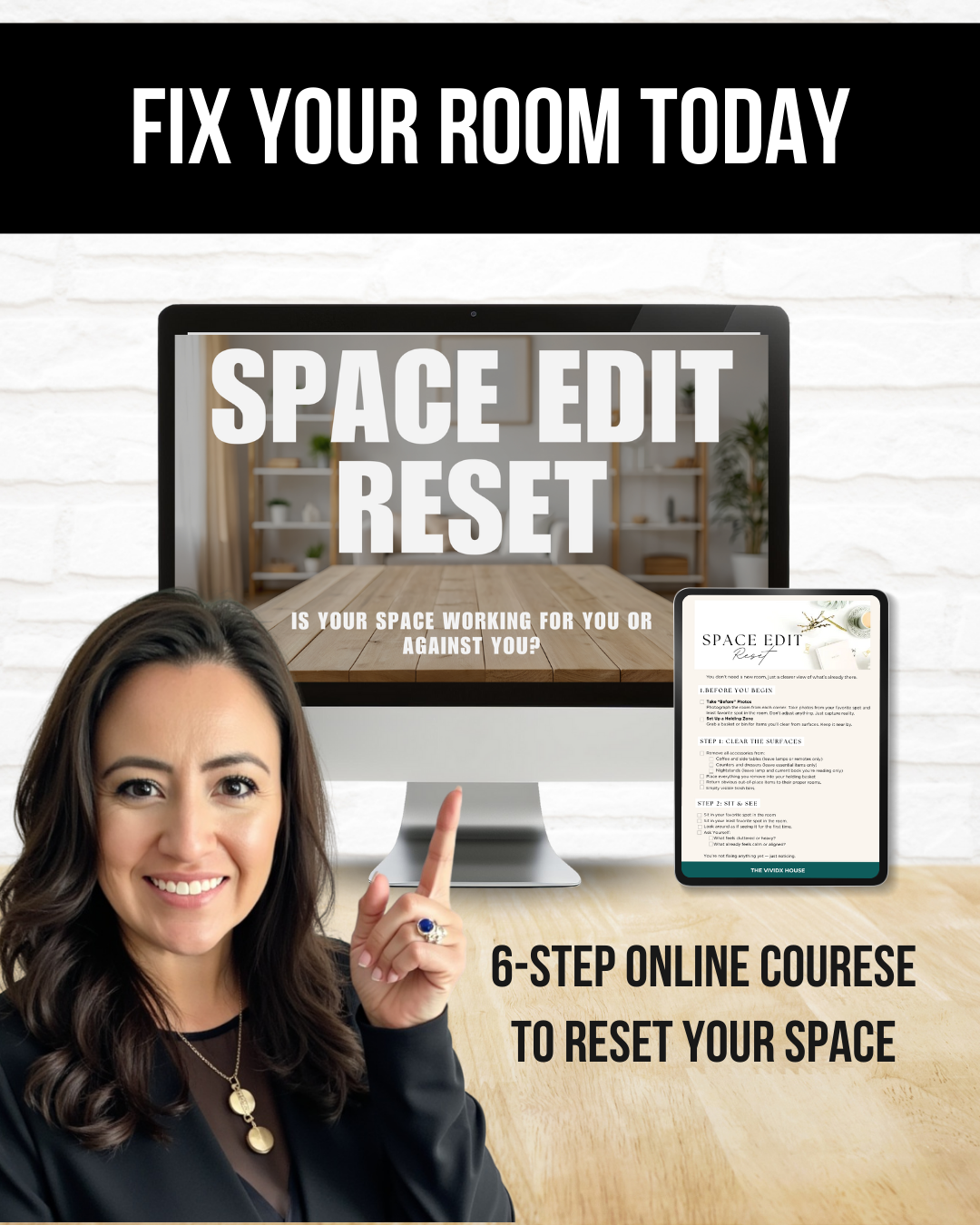
Why Does My Space Feel Hard to Live In?
You move through your home and everything feels like extra work. The living room never feels comfortable. The bedroom never feels restful. The kitchen never feels intuitive. The hallway slows you down. The entire home feels inconvenient in ways you cannot quite put into words. Nothing is wrong, but nothing is easy.
A space feels hard to live in when the structure makes daily movement feel like effort.
This has nothing to do with your habits or your personality.
This has nothing to do with clutter or cleanliness.
This is a foundational issue inside the architecture of your rooms.
A home becomes hard to live in when the structure fights your natural patterns
Your space feels difficult when:
• the walkway interrupts your stride
• the anchor is pointed in the wrong direction
• the seating zone is unbalanced
• the scale disrupts movement
• the walls feel uneven
• the surfaces feel heavy
• the room’s purpose does not match your life
Living becomes harder because the environment is not supporting you.
Here are the real reasons your space feels hard to live in
1. The walkway forces you to think about how you move
A good walkway disappears.
A bad walkway makes itself known every time you take a step.
If you must:
• slow down
• angle your body
• squeeze around furniture
• shift your path
the home is adding friction to your life.
2. The anchor works against the room’s architecture
A misaligned sofa, bed, or table disrupts the entire function of the room.
Your body senses instability, even if your eyes do not.
3. The seating zone is not supporting the way you use the space
A seating zone that is too spread out creates disconnect.
A seating zone that is too tight creates pressure.
Both make the room feel difficult to relax in.
4. The scale of the furniture makes the room harder to navigate
Oversized furniture dominates circulation.
Undersized furniture creates awkward gaps.
Either way, movement becomes uncomfortable.
5. The walls are visually unbalanced
One wall feels too heavy.
Another feels too empty.
Your body feels the imbalance long before your eyes interpret it.
6. The surfaces create visual weight you cannot escape
Even tidy surfaces can feel heavy if they carry:
• tall lamps
• layered objects
• stacks
• dense decor
Visual weight makes the room feel tiring.
7. The purpose of the room is unclear
A room trying to be too many things makes your brain work harder than necessary.
Purpose creates ease.
Confusion creates effort.
Why organizing does not make living easier
Most homeowners respond to a difficult home by:
• decluttering
• rearranging decor
• adding storage
• buying baskets
• restyling shelves
But when the structure is wrong, none of this reduces effort.
You cannot organize your way out of poor architecture.
Ease is created by alignment, not organization
A space becomes easy to live in when:
• the anchor is correct
• the walkway is clear
• the scale is appropriate
• the sightlines are calm
• the walls are balanced
• the purpose is defined
Ease is a structural experience.
This is exactly why the Space Edit Reset™ works
The Space Edit Reset™ helps you understand why your home feels hard to live in, and gives you the system to rebuild the structure so the house finally supports your daily life.
Inside the Reset, you learn how to:
• observe movement patterns
• clear the visual noise
• identify the correct anchor
• open the walkway
• balance visual weight
• reset the space with intention
Once the structure is aligned, living becomes effortless.
Two simple tests to reveal what is making your home difficult
1. Walk through your home carrying a laundry basket or tray
If your body must shift around obstacles, the structure is creating effort.
2. Sit in the main seat and look toward the heaviest wall
If that wall feels visually loaded or out of balance, it is contributing to the sense of difficulty.
A real homeowner moment
A homeowner once told me her home “made everything harder.” She felt like she was constantly adjusting, bending, and maneuvering around obstacles. She assumed she needed better organization.
Once we applied the Reset, the issue became clear.
Her anchor fought the architecture.
The walkway was constricted.
The walls were unbalanced and heavy.
We realigned the structure.
Movement became effortless.
Rooms felt easier.
Daily tasks felt lighter.
She didn’t realize her home could support her life instead of draining it.
Your next step
If your space feels hard to live in, the problem is not your routines. It is your structure. The Space Edit Reset™ teaches you how to create alignment so living in your home finally feels easy and grounded.
Apply these principles inside The Space Edit Reset™.
Is your space working for you or against you?
JOIN THE FACEBOOK GROUP: The Space Edit Reset Group
Why Does Every Room Feel Like It’s Fighting Me?
You walk through your home and nothing feels easy. The living room feels tense. The bedroom feels unsettled. The hallway feels awkward. The dining room feels tight. It is as if every room works against you instead of supporting you. You can feel the resistance in your body. You try to rearrange small things, but the tension stays.
A home feels like it is “fighting you” when the structure is in conflict.
This is not about clutter.
This is not about decor.
This is about how the anchor, walkway, scale, and sightlines push against the way you naturally move and rest.
A room fights you when the structure blocks the way your body wants to move
Your home feels oppositional when:
• the anchor is in the wrong place
• the walkway forces unnatural movement
• the seating zone is too wide or too tight
• the furniture scale disrupts circulation
• the walls carry uneven visual weight
• the sightlines create pressure
• the purpose of the room does not match your life
When any one of these is off, the room resists you.
When multiple are off, the entire home feels confrontational.
Here are the real reasons your rooms feel like they’re pushing back
1. The walkway forces friction
If you have to slow down, angle your body, squeeze past furniture, or take unnecessary steps, the room is physically resisting you.
Flow is the foundation of comfort.
When flow breaks, resistance appears.
2. The anchor pulls the room in the wrong direction
A sofa pointed at the wrong wall, a bed centered incorrectly, or a dining table placed off balance creates immediate tension.
Your body can sense that the anchor does not match the architecture.
3. The seating zone does not fit the room
When the sofa and chairs sit too far apart or too close together, the room feels uncomfortable.
Distance creates disconnect.
Tight spacing creates pressure.
Either way, your body feels pushed.
4. The furniture scale dominates or disappears
Oversized pieces create a sense of suffocation.
Undersized pieces create instability.
Rooms fight you when the scale contradicts the size of the architecture.
5. The surfaces carry too much height or density
Even when tidy, tall lamps, layered decor, or heavy consoles create a feeling of congestion.
This visual pressure makes the room feel confrontational.
6. The room is not designed for the life you live now
A room built for past routines will always resist your current movement patterns.
Your home is fighting your life because it is built for a previous version of you.
Why styling and decluttering never fix a room that feels oppositional
Most homeowners try:
• new decor
• more storage
• rearranging accessories
• removing items
But none of these address the structural cause.
The resistance comes from how the room is constructed, not how it is decorated.
Rooms stop fighting you when the structure supports your movement
A supportive room has:
• a grounded anchor
• an effortless walkway
• balanced walls
• proportional scale
• clean sightlines
• a clear purpose
When these elements work together, the room feels like it is on your side.
This is exactly why the Space Edit Reset™ works
The Space Edit Reset™ diagnoses the structural friction in your home and shows you how to rebuild each room so it works with you instead of against you.
Inside the Reset, you learn how to:
• observe the room through the lens of ease
• clear surfaces so the architecture is revealed
• find the correct anchor
• open the walkway
• balance visual weight
• reset the room with grounded placement
Once the structure is aligned, the resistance dissolves.
Two simple tests that reveal what the room is fighting against
1. Walk the room with a natural stride
Do not look down.
Notice where your body adjusts.
Every point of hesitation is where the room is resisting you.
2. Pull the anchor forward by two inches
Move the sofa, bed, or table slightly forward.
If the room instantly feels calmer, the walls were creating pressure.
A real homeowner moment
A homeowner once told me, “Every room in my house feels like it’s fighting me.”
She avoided her living room.
She rushed through the hallway.
She never relaxed in the bedroom.
When we applied the Reset, the truth surfaced.
Her anchors were all pointed at the wrong focal points.
Her walkways were tight or angled.
Her surfaces were heavy.
Every room forced friction into her body.
We corrected the anchor, opened the circulation, and simplified the sightlines.
The resistance disappeared.
Her home finally stopped arguing with her.
Your next step
If your rooms feel like they are fighting you, the problem is not your decor. It is the structure. The Space Edit Reset™ teaches you how to realign your home so every room works with you, not against you.
Apply these principles inside The Space Edit Reset™.
Is your space working for you or against you?
JOIN THE FACEBOOK GROUP: The Space Edit Reset Group
Why Does My Home Feel Like Too Much Is Going On?
You walk through your home and instantly feel overstimulated. The rooms look fine in photos, but in person everything feels loud. Your eye jumps from wall to wall. Your body feels unsettled. Even when the home is clean, the space feels like it has too much happening at once. You do not know where to look. You do not know where to settle. You feel pulled in several directions at the same time.
A home feels like “too much is going on” when the structure overwhelms the senses.
This is not about mess or clutter.
This is about how the layout, sightlines, and visual weight collide with each other.
A home feels overstimulating when the architecture is competing for attention
Your home feels like too much is going on when:
• the sightlines fight each other
• the anchor pulls energy in the wrong direction
• the surfaces carry too much height or density
• the scale jumps dramatically between pieces
• the walkway forces unnatural movement
• the purpose of each room is unclear
You experience overwhelm because the room is giving your body and your eyes too many signals at once.
Here are the real reasons your home feels overstimulating
1. Your sightlines compete instead of guide
If you walk into a room and your eye hits:
• a heavy wall
• a cluster of decor
• a tall piece of furniture
• objects stacked on a surface
before it can land on the anchor, the room feels chaotic.
Your eyes crave order.
Competing sightlines create noise.
2. Your anchor is not grounding the space
An anchor that is misaligned or under-supported allows the room to pull in multiple directions.
Without a strong anchor, everything else becomes louder.
3. Your surfaces carry multiple layers of height
Even when surfaces are tidy, tall or layered objects create an overstimulating effect.
Your eyes must work too hard to interpret the vertical weight.
Height creates noise.
Density reinforces it.
4. The walkway forces tension
A walkway that makes you shift or squeeze increases the sense of overwhelm.
Your body responds instantly to friction.
Flow determines calmness.
5. The scale of the furniture is inconsistent
A deep sofa next to small tables.
Tall lamps next to low-backed seating.
A tiny rug under a large sectional.
Scale mismatches create visual noise that looks like “too much” even if the room is sparsely furnished.
6. The room lacks a clear purpose
When a room tries to serve too many functions, the experience becomes noisy.
Purpose organizes behavior.
Without direction, the room becomes confusing.
Why removing decor rarely solves the issue
Most homeowners respond to overstimulation by:
• decluttering
• removing decor
• simplifying shelves
• hiding items in baskets
But when the structure is misaligned, decluttering does not quiet the room.
It simply reduces objects without addressing the root cause.
The real issue is not how much you have.
The real issue is how the room carries weight.
A calm home is created by structure, not minimalism
A home stops feeling overstimulating when:
• the anchor is correct
• the sightlines are clean
• the scale feels proportional
• the walkway feels effortless
• the walls feel balanced
• the purpose is clear
Calm is structural.
Not decorative.
This is exactly why the Space Edit Reset™ works
The Space Edit Reset™ helps you identify the architectural reasons your home feels like too much is going on.
It gives you a method for quieting the space without stripping it bare.
Inside the Reset, you learn how to:
• observe the home with clarity
• clear surfaces to reveal the structural noise
• identify and correct the anchor
• lighten the sightlines
• balance visual weight
• rebuild the layout in a grounded way
Once the structure is aligned, the room finally feels calm.
Two simple tests that reveal the source of overstimulation
1. Take six photos from the corners of the room
If every photo shows multiple competing focal points, the structure is creating noise.
2. Remove the tallest object in your immediate sightline
Tall objects amplify visual noise.
Removing even one often reveals the true source of overwhelm.
A real homeowner moment
A homeowner once told me every room in her house felt like “too much.” She decluttered constantly. She removed decor. She rearranged surfaces every week. Nothing changed.
When we applied the Reset, the issue became clear.
Her anchor was misaligned.
Her sightlines were overloaded.
Her scale was inconsistent from one room to the next.
We corrected the anchor, lightened the surfaces, and balanced the walls.
The home became instantly calmer without removing half her belongings.
She said, “My home finally breathes.”
Your next step
If your home feels like too much is going on, the issue is not clutter. It is structural noise. The Space Edit Reset™ teaches you how to rebuild the space so your home feels calm, grounded, and complete.
Apply these principles inside The Space Edit Reset™.
Is your space working for you or against you?
JOIN THE FACEBOOK GROUP: The Space Edit Reset Group
Why Does My Home Feel Like It Has No Flow?
You move through your home and something feels disjointed. Each room feels separate instead of connected. You turn corners awkwardly. You step around furniture. You slow down without meaning to. You have to think about how to move instead of just moving. It feels like the house is interrupting you at every turn.
A home with poor flow always feels harder to live in, even when everything looks clean and put together.
Flow has nothing to do with decor.
Flow is created by structure.
Flow is a spatial experience, not a design aesthetic
Your home feels like it has no flow when:
• the walkway is blocked or forced
• the anchor pulls the room in the wrong direction
• the furniture is not scaled to the space
• the rooms compete instead of support one another
• the sightlines feel broken
• the purpose of each room is unclear
Poor flow is a structural issue that disrupts the entire home.
Here are the real reasons your home has no flow
1. The walkway makes you adjust your body
If you have to pause, turn sideways, or navigate around furniture, the flow is broken.
Movement should feel natural and uninterrupted.
Any friction affects the entire room.
2. The anchor pulls the room off balance
If the sofa points toward the wrong wall, or the bed sits in a way that cuts the room in half, the flow stops immediately.
Anchors shape circulation more than any other element.
3. The scale disrupts movement
Oversized pieces cause bottlenecks.
Undersized pieces make the layout feel hollow and confusing.
A room with mismatched scale forces awkward movement, which destroys flow.
4. The rooms do not speak the same architectural language
One room may feel heavy, another too empty, another too tight.
When rooms do not support each other, the flow feels broken across the entire home.
Consistency creates flow.
5. The sightlines are busy or blocked
Your eye wants a clear path just as much as your body does.
If the moment you look into a room you see crowded surfaces or heavy walls, the home feels clogged.
6. The purpose of the space is unclear
When a room tries to do too many things, circulation suffers.
A home with unclear purpose always has poor flow.
Why styling cannot fix a home with no flow
Homeowners often try to solve flow issues by:
• rearranging decor
• swapping pillows
• adding rugs
• buying storage
• restyling shelves
But none of this changes how your body moves through space.
Flow is not a style problem.
Flow is a structural issue that must be rebuilt from the foundation.
A home flows well when structure guides movement
A home with strong flow has:
• a grounded anchor
• clean walkways
• balanced sightlines
• proportional scale
• consistent room purpose
• alignment from one room to the next
When these are in harmony, your body moves naturally and your home feels effortless.
This is exactly why the Space Edit Reset™ works
The Space Edit Reset™ shows you how to rebuild a room’s structure so flow becomes intrinsic instead of accidental.
Inside the Reset, you learn how to:
• observe how your body moves through each room
• clear the obstacles blocking circulation
• identify the correct anchor
• rebalance the scale
• lighten the sightlines
• rebuild each room so the flow supports the entire home
Once the structure is aligned, flow becomes automatic.
Two simple tests to discover what is blocking your home’s flow
1. Walk through your home without looking down
Feel where your body slows down, angles, or shifts.
That is where the flow breaks.
2. Pull the anchor forward two inches
This small adjustment often opens the entire room’s circulation.
If the space feels easier to move through, the walls were creating unnecessary pressure.
A real homeowner moment
A homeowner once told me her home “had no flow at all.” She felt like she was zigzagging through the house even though everything looked organized. She assumed the issue was clutter.
Once we applied the Reset, the truth surfaced.
Her walkway was blocked by furniture that looked fine in photos but created friction in real life.
Her anchors pulled each room in conflicting directions.
The sightlines were overloaded.
We realigned the anchors, opened the paths, and simplified the sightlines.
The home flowed instantly.
She said, “I didn’t know my house could feel easy.”
Your next step
If your home feels like it has no flow, the problem is not your decor. It is the structure. The Space Edit Reset™ teaches you how to rebuild your home so movement feels natural, grounded, and effortless.
Apply these principles inside The Space Edit Reset™.
Is your space working for you or against you?
JOIN THE FACEBOOK GROUP: The Space Edit Reset Group
Why Does My Home Feel Too Busy Even When It’s Clean?
You clear the counters. You put items away. You straighten the shelves. You remove clutter. For a moment the room looks tidy, but the busy feeling never leaves. The space feels loud even when nothing is out of place. The room feels active in a way that makes you want to move instead of settle.
A home feels busy when the structure overloads the eye.
This has nothing to do with mess.
This is about how the architecture, layout, and visual weight work together.
A busy room is a room that carries more information than your body can process at once.
A clean room can feel busy when the structure is overstimulating
A room becomes visually busy when:
• the anchor is misaligned
• the sightlines are overloaded
• the surfaces carry too much weight
• the walls hold too many competing elements
• the walkway creates friction
• the scale is mismatched
Your body interprets visual conflict as “busyness,” even if everything is clean.
Here are the real reasons your home feels too busy
1. The sightlines carry too much information
When you walk into a room and your eye hits multiple objects, shapes, or focal points at once, the space feels busy.
Your eye needs direction.
Without it, the room feels chaotic.
2. The surfaces hold tall or layered objects
Even clean surfaces can feel heavy if:
• the objects are tall
• the objects are stacked
• the decor is layered
• the heights compete
Visual weight is more important than quantity.
3. The walls are unbalanced
If one wall has heavy furniture or art and the opposite wall is bare, your eye bounces back and forth trying to understand the imbalance.
This creates the sensation of busyness.
4. The walkway interrupts movement
Busy movement equals a busy home.
If you have to step around corners or adjust your path, the room feels tense even if it is tidy.
Your body feels the friction before your eyes notice anything.
5. The anchor is not grounding the room
The anchor sets the tone.
If the sofa, bed, or table is not aligned to the true focal point, the entire room feels unsettled.
Unsettled equals busy.
6. The scale feels inconsistent
Oversized furniture next to small decor pieces or tiny rugs under large sofas create visual contrast that overstimulates the eye.
A space with mismatched scale always feels noisy.
Why decluttering doesn’t solve a busy-feeling home
Most homeowners try to fix busyness by:
• removing items
• clearing surfaces
• simplifying decor
• hiding things in baskets
But the problem is not quantity.
The problem is structure.
A room with an overloaded sightline will feel busy even if it contains only three objects.
A home stops feeling busy when the layout supports the eye
A calm home has:
• a grounded anchor
• balanced walls
• proportional scale
• clear sightlines
• spacious but not exaggerated walkways
• intentional surfaces
These elements create visual quiet.
This is exactly why the Space Edit Reset™ works
The Space Edit Reset™ shows you how to remove visual noise by correcting the structure of the room.
Inside the Reset, you learn how to:
• observe the room without distractions
• clear surfaces to reveal the source of busyness
• identify the correct anchor
• rebalance the walls
• lighten the sightlines
• rebuild the room so it feels calm
Once the structure is right, the busy feeling disappears instantly.
Two simple tests to see why your room feels busy
1. Clear the main sightline completely
Stand in the doorway.
Remove everything you see first.
If the room feels calmer, the busyness was visual overload.
2. Remove one tall or layered object from each surface
Tall items or layered decor introduce vertical noise.
Removing them reveals whether the height or density was creating the busyness.
A real homeowner moment
A homeowner once told me her home felt busy even after she decluttered obsessively. She cleaned constantly, but the tension never left.
When we applied the Reset, the issue became clear.
Her sightlines were overloaded.
Her anchor was pointed at the wrong focal point.
Her surfaces carried tall layers that overwhelmed the room.
We corrected the anchor, lightened the surfaces, and simplified the sightlines.
The busy feeling disappeared without removing half her belongings.
She said, “My home finally feels quiet.”
Your next step
If your home feels busy even when it is clean, the issue is not clutter. It is visual overload. The Space Edit Reset™ teaches you how to realign the structure so your home feels calm, grounded, and complete.
Apply these principles inside The Space Edit Reset™.
Is your space working for you or against you?
JOIN THE FACEBOOK GROUP: The Space Edit Reset Group
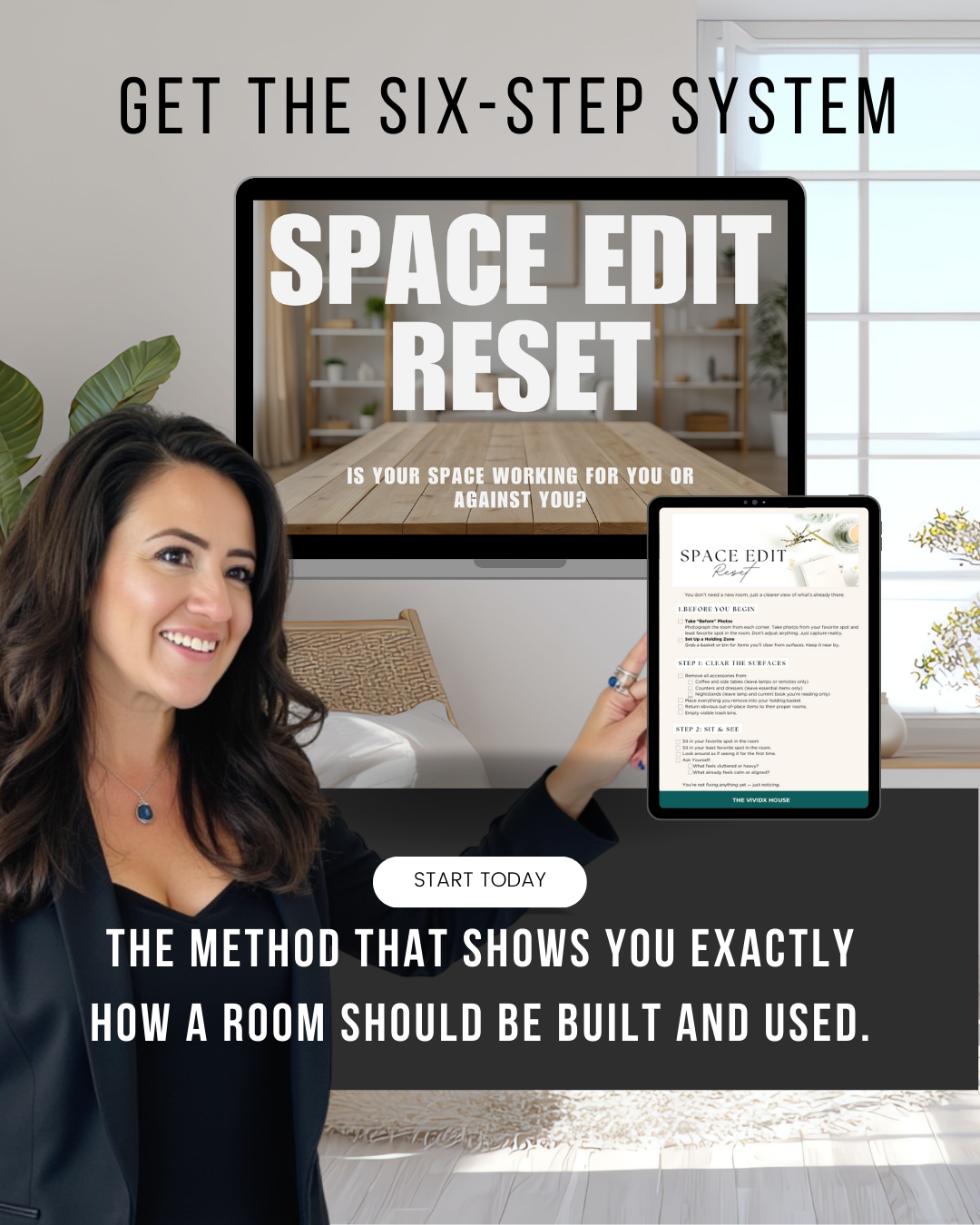
Why Does My Home Feel Disconnected From Room to Room?
You walk from the living room to the hallway, then into the bedroom, and the feeling shifts in every direction. One room feels heavy. Another feels empty. Another feels tight. Another feels unfinished. Nothing feels cohesive. Nothing feels like part of the same home. Even though each room may look fine on its own, the entire house feels fragmented.
A home feels disconnected when the structure breaks from room to room.
This has nothing to do with matching decor or color palettes.
This is about the architectural rhythm of your home not working as a whole.
A disconnected home is a structural issue across multiple rooms
Your house feels disconnected when:
• the anchors point in conflicting directions
• the walkway changes pattern from room to room
• the scale shifts dramatically between spaces
• the sightlines fight each other
• the visual weight is uneven across the home
• the purpose of each room is unclear
Homes feel cohesive when the structure is consistent.
Homes feel disconnected when each room follows its own logic without supporting the next.
Here are the real reasons your home feels disconnected
1. The anchors are misaligned between rooms
Every room has a main anchor.
But if one anchor points north, another points west, and another points toward a random wall, the entire home feels disjointed.
Anchors should create a shared direction, not compete for dominance.
2. The walkway shifts in unpredictable ways
You may walk straight through one room, then curve sharply through another, then squeeze through a third.
Even if you do not consciously notice it, your body does.
Inconsistent circulation is one of the biggest causes of a home that feels disconnected.
3. The scale changes drastically between rooms
A large, deep sectional in the living room paired with tiny nightstands in the bedroom creates uneven weight across the home.
Your brain reads this as inconsistency.
Scale must feel related from room to room.
4. The walls carry weight unevenly
If one room has fully developed walls and another room is bare or underbuilt, the home feels visually lopsided.
A cohesive home distributes weight evenly.
5. There is no shared architectural rhythm
Rooms are not islands.
They relate to each other through:
• sightlines
• patterns of movement
• proportional relationships
• anchor alignment
When these are mismatched, the home loses unity.
6. The purpose of rooms overlaps or competes
A dining room trying to be a workspace.
A bedroom trying to be a storage area.
A living room trying to hold every function at once.
Purpose confusion creates home-wide disconnection.
Why decorating cannot fix a disconnected home
Most homeowners try to create flow by:
• matching colors
• repeating materials
• coordinating pillows
• buying similar decor
• adding plants everywhere
But decor cannot create architectural flow.
Structure creates flow.
Decor enhances what structure supports.
What creates a home that feels cohesive
A cohesive home has:
• anchors that align
• walkways that follow a natural pattern
• scale that stays proportional
• sightlines that feel intentional
• walls that are balanced across rooms
• purpose that is clear in every space
These elements create a steady rhythm that carries from room to room.
This is exactly why the Space Edit Reset™ works
The Space Edit Reset™ is not just a system for fixing individual rooms. It is a framework for aligning your entire home.
Inside the Reset, you learn how to:
• observe each room through the same structural lens
• clear visual noise so alignment becomes visible
• identify and correct competing anchors
• unify the circulation pattern
• balance visual weight across spaces
• rebuild each room so the flow feels consistent
Once the structure is aligned, the home feels cohesive even before you add decor.
Two tests that reveal why your home feels disconnected
1. Stand in the hallway and look into every visible room
If each room tells a different structural story, the home feels disconnected.
Look for:
• different anchor directions
• different scale patterns
• heavy walls next to empty walls
This reveals the break in flow.
2. Walk from the entry to the farthest room without stopping
Notice how many times you shift direction, adjust your body, or pause.
Each interruption signals a structural break that disrupts unity.
A real homeowner moment
A homeowner once told me her house felt like a collection of mismatched rooms. Each space looked fine alone, but the home felt chaotic as a whole.
Once we used the Reset, the issue became clear.
The anchors in every room pointed in different directions.
The walkways zigzagged.
The rooms did not support each other.
We realigned the anchors, adjusted the walkways, and balanced the walls.
The entire home felt unified without adding a single new item.
She finally felt like it was one home instead of eight separate rooms.
Your next step
If your home feels disconnected from room to room, the problem is not decor. It is structure. The Space Edit Reset™ teaches you how to align the entire home so every room works together instead of apart.
Apply these principles inside The Space Edit Reset™.
Is your space working for you or against you?
JOIN THE FACEBOOK GROUP: The Space Edit Reset Group
How to Fix a Room Without Buying Anything New
Most people reach a point where they stand in the middle of a room and think, I need to buy something to fix this. A new lamp, a new rug, a new piece of art. But then the boxes arrive, and nothing actually changes. The room still feels off. The frustration stays.
The real problem isn’t a lack of decor. It’s a lack of structure.
A room stops working long before the budget does. What you’re feeling is misalignment between function, placement, and visual weight. And no amount of shopping replaces the step that’s missing.
This is exactly why The Space Edit Reset™ exists.
What’s Actually Happening in a Room That Isn’t Working
When a space feels wrong, it usually comes down to three invisible issues:
1. Visual overload
Too many small objects compete for attention. Even clean surfaces can feel busy depending on the distribution and scale of what’s there.
2. Layout friction
Furniture can technically fit but still interrupt how you move, sit, reach, or see across the room. When the anchor pieces are locked in place for years, you stop noticing how much resistance they create.
3. Identity mismatch
Rooms often hold objects from older chapters of your life. That mismatch changes how the space feels even if nothing looks messy.
You don’t fix these issues by adding more things. You fix them by seeing the room clearly again.
The Step Most People Skip
Most homeowners jump straight into decorating. They style shelves, add baskets, hang art, and hope it solves the feeling. But styling is Step Six of a design process, not Step One.
What’s missing is a reset.
The Space Edit Reset™ teaches you how to correct the room at the foundation level before a single dollar is spent. It’s the difference between rearranging and transforming.
Here’s How to Fix a Room Today Without Buying a Single Thing
These moves create immediate change because they reveal the truth of the room instead of masking it.
1. Clear One Surface Completely
Pick the surface that catches the most items:
the coffee table, the nightstand, the kitchen counter by the fridge.
Remove everything and step back.
You’ll be surprised at how quickly your eyes relax.
This is the “Observe” and “Strip” stage of the Space Edit Reset™. It lets you see what the room has actually been holding.
2. Sit in Three Different Spots
Move to places you never sit. The corner. The opposite end of the sofa. The chair that’s mostly decorative.
From each angle, notice:
What feels heavy?
What feels crowded?
What suddenly looks right?
This is how you diagnose what’s working and what’s not. It’s not emotional guessing. It’s spatial reading.
3. Pull the Anchor Piece Forward
Whether it’s the sofa, the bed, or the dining table, pull it away from the wall by two or three inches.
This small shift softens the entire room and immediately removes the “boxed in” feeling that stops a space from feeling comfortable.
4. Reintroduce Only What Belongs
Go back to the items you cleared from the surface.
Ask one question:
Does this belong in this room?
If the answer is yes, it returns.
If the answer is no, place it in a shuttle bin at the doorway.
If you’re unsure, it becomes a Later Box item.
This is the heart of the Space Edit Reset™. Nothing random. Nothing placed out of habit.
5. Look at the Room as If You Were Seeing It for the First Time
Walk through your front door, pause at the threshold of the room, and let your eyes land where they naturally go.
If the first thing you see feels crowded or visually loud, that area is your next micro-reset zone.
You haven’t bought anything new, yet the room is already functioning differently.
A Real-Life Example
A client once asked me why her living room felt wrong even though everything in it was beautiful. The sofa was high-quality. The coffee table was solid wood. The decor was tasteful. But she avoided the room every evening.
We started with a reset instead of a shopping list.
We cleared the surfaces. We sat in multiple spots. We pulled the sofa forward. We relocated several items that belonged in the office, not the living room. Nothing new was purchased.
When she walked back in, she stopped in the doorway.
The room finally matched the life she was living now, not the life she lived five years ago when she bought the furniture.
That shift had nothing to do with buying anything. It came from seeing the room clearly for the first time.
Why This Works
Because the problem was never about decor.
It was about structure and support.
The Space Edit Reset™ corrects what’s underneath the styling decisions. It shows you how to make a room work before you ever decorate it.
If you want to go deeper and see these steps demonstrated in real homes, start with The Space Edit Reset™. And when you’re ready for full-scale transformation, that’s what the Transformative Home Experience is built for.
Your home can work. You just need a reset, not more shopping.
Apply these principles inside The Space Edit Reset™. Is your space working for you or against you?
Why Does My Home Never Feel ‘Done’?
You finish cleaning. You rearrange the furniture. You update the decor. You buy something new. You style the shelves again. For a few hours the room feels better, but the sense of completion never lasts. No matter how much effort you put in, your home never feels finished. It always feels like something is missing, something is off, or something needs to be changed.
This is one of the most common frustrations homeowners face.
And it has nothing to do with taste or effort.
A home feels unfinished when the structure is not aligned.
A home never feels done when the foundation is still unsettled
You cannot create a sense of completion with decor alone.
Completion comes from structure.
Your home will always feel unfinished when:
• the anchor is misaligned
• the walkway is interrupted
• the scale does not match the room
• the walls carry uneven visual weight
• the surfaces hold too much density
• the sightlines create tension
• the room’s purpose is unclear
Until these structural elements are corrected, your home cannot feel complete.
Here are the real reasons your home never feels finished
1. The anchor is not in the right place
If the main furniture piece is centered visually but not architecturally, the room will always feel slightly off.
Completion requires a grounded anchor.
2. The walkway creates subtle friction
Even small disruptions in movement create a sense of incompletion.
If you cannot walk cleanly through a room, your brain registers it as unfinished.
3. The scale is not supporting the room
A rug that is too small, a sofa that is too deep, or a coffee table that is too narrow makes the entire room feel underbuilt.
Scale determines whether a room feels complete.
4. The visual weight is unbalanced
One wall feels too heavy.
Another wall feels too empty.
Your eye moves around trying to make sense of the imbalance, which creates a feeling of “not done.”
5. The surfaces hold static, predictable decor
Rooms stop evolving when the decor becomes repetitive.
Predictable surfaces create stagnation, which reads as unfinished.
6. The room’s purpose has not been defined
A room without a clear direction can never feel complete.
Purpose is what tells the architecture where to support you.
Why buying more does not create a sense of “done”
Homeowners often try to:
• add more decor
• buy new pillows
• repaint the walls
• purchase storage
• upgrade accessories
But completion is not a decor issue.
It is a structural issue.
A room looks more finished when the structure is correct, not when the shelves are full.
Completion comes from alignment, not accessories
A home feels done when:
• the anchor is correct
• the walkway is clean
• the scale feels proportional
• the walls feel balanced
• the surfaces feel intentional
• the purpose is unmistakably clear
Completion is the natural result of a grounded structure.
This is exactly why the Space Edit Reset™ works
The Space Edit Reset™ helps you understand why your home never feels done.
It reveals the foundational misalignment and teaches you how to rebuild the structure from the ground up.
Inside the Reset, you learn how to:
• observe the room with clarity
• clear the visual noise
• locate the true anchor
• open circulation
• balance the walls
• reset the room with intention
Once the structure is aligned, the feeling of “unfinished” disappears.
Two simple tests to reveal what is preventing completion
1. Stand at the doorway and track your eye movement
If your eye jumps instead of glides, the home is not balanced.
This is the number one reason homes feel unfinished.
2. Pull the anchor forward two inches
Move the sofa, bed, or dining table slightly forward.
If the room feels instantly more grounded, the walls were creating pressure that blocked the feeling of completion.
A real homeowner moment
A homeowner once told me her home had never felt finished in ten years. She painted. She styled. She decluttered. She bought new pieces. But the sensation never went away.
Once we applied the Reset, the issue became obvious.
Her anchors were all visually centered but not architecturally grounded.
The walkways forced slight angles.
The walls carried heavy weight on one side and almost none on the other.
We corrected the structure.
The home felt complete within minutes.
She had been trying to finish this house with decor. She needed to finish it with structure.
Your next step
If your home never feels done, the issue is not your decor. It is your foundation. The Space Edit Reset™ teaches you how to build a structure that feels complete every time you walk through the door.
Apply these principles inside The Space Edit Reset™.
Is your space working for you or against you?
JOIN THE FACEBOOK GROUP: The Space Edit Reset Group
Why Does My Home Look Fine but Still Feel Wrong?
You walk through your home and everything looks acceptable. The decor matches. The furniture is in good condition. The color palette is cohesive. Nothing jumps out as a problem. But the moment you step into each room, something feels wrong. You feel unsettled. You feel a quiet tension. The space looks fine but does not feel right.
This disconnect is one of the biggest signs that the structure of your home is misaligned.
A home can look perfect in photos but feel uncomfortable in person when the architecture and layout are working against you.
A home looks right but feels wrong when the structure does not support the experience
Your home is sending you signals.
When everything looks good but feels off, the issue lives beneath the surface.
Homes feel wrong when:
• the anchor is centered visually but not structurally
• the walkway is creating friction
• the furniture scale does not match the room
• the walls carry uneven visual weight
• the sightlines are crowded or interrupted
• the room’s purpose has not been defined
You are not imagining it.
Your body responds to these issues long before your eyes do.
Here are the real reasons your home feels wrong even though it looks right
1. The anchor is aligned to the wrong reference point
You may have centered your sofa to the TV, your bed to the wall, or your dining table to a light fixture.
But the true focal point may be:
• a window
• a fireplace
• the architectural center of the room
• the strongest visual line
When the anchor is visually centered but architecturally wrong, the room looks correct and feels incorrect.
2. The walkway forces micro adjustments
Even tiny adjustments in the way you move create tension.
If you have to shift your step around a table or angle around a chair, your home feels wrong no matter how clean or styled it is.
3. The scale feels slightly off
Scale issues can be subtle but powerful.
Examples:
• a rug just slightly too small
• a coffee table that sits too far away
• side tables that feel undersized
• art that floats too high
A room with mismatched scale looks fine in photos but feels wrong in person.
4. The visual weight is unbalanced
When one wall carries too much weight and another wall carries almost none, the home feels unstable.
Your eyes bounce around trying to make sense of the imbalance.
Even if the decor is beautiful, the room feels wrong.
5. The room’s purpose does not match your current life
A room may look good and still feel wrong because it is designed for a past version of your habits.
Purpose determines how a space should support you.
When the room does not match the way you live today, it feels disconnected.
Why “fixing the decor” never fixes the feeling
Most homeowners respond to this discomfort by:
• adding new art
• changing pillows
• buying fresh decor
• swapping styles
• adding plants
• rearranging small items
But none of these solve the structural problem beneath the surface.
Decor adjusts appearance.
Structure adjusts experience.
This is exactly why the Space Edit Reset™ works
The Space Edit Reset™ reveals the structural truth behind why your home feels wrong.
It helps you see what your body already senses.
Inside the Reset, you learn how to:
• observe the room with clarity
• clear surfaces so the architecture becomes visible
• identify the correct anchor
• balance the walls
• adjust the walkway for ease
• reset the entire room with purpose
Once the structure is correct, the room finally feels right.
Two simple tests to reveal why your home feels wrong
1. Stand at the doorway and study where your eyes land first
If your eye hits something heavy, crowded, or out of alignment, that is the source of the discomfort.
2. Pull the anchor piece forward two inches
Sofas, beds, tables.
Move the anchor forward slightly.
If the room feels instantly lighter, the walls were creating pressure that decor could never fix.
A real homeowner moment
A homeowner once told me her living room “looked perfect but felt wrong.” She could not explain it. Everything matched. Everything was styled. Everything looked good in photos.
But when we applied the Reset, the issue became clear.
Her sofa was centered visually but not centered to the room’s architecture.
The walkway forced a slight angle.
The walls were unevenly weighted.
We corrected the anchor and opened circulation.
She walked in and said, “It finally feels like my home.”
Your next step
If your home looks fine but still feels wrong, the solution is not new decor. It is alignment. The Space Edit Reset™ teaches you how to rebuild the structure beneath your rooms so they finally feel grounded, supportive, and complete.
Apply these principles inside The Space Edit Reset™.
Is your space working for you or against you?
JOIN THE FACEBOOK GROUP: The Space Edit Reset Group