
Why a “Perfectly Styled” Home Can Still Create Internal Chaos
Your clients scroll social media, see immaculate homes, and think they know exactly what theirs should look like. They recreate the look. They choose the right furniture. They match colors, hang artwork, arrange pillows, and lay out a room that photographs beautifully.
Then they sit down to relax and feel everything but calm.
The room is clean.
The décor is coordinated.
Nothing is out of place.
Yet something feels chaotic.
The nervous system does not care that the room looks perfect.
It cares how the room functions.
This is the missing piece most design content ignores and therapists instantly recognize: a room can be aesthetically flawless and still work against the body.
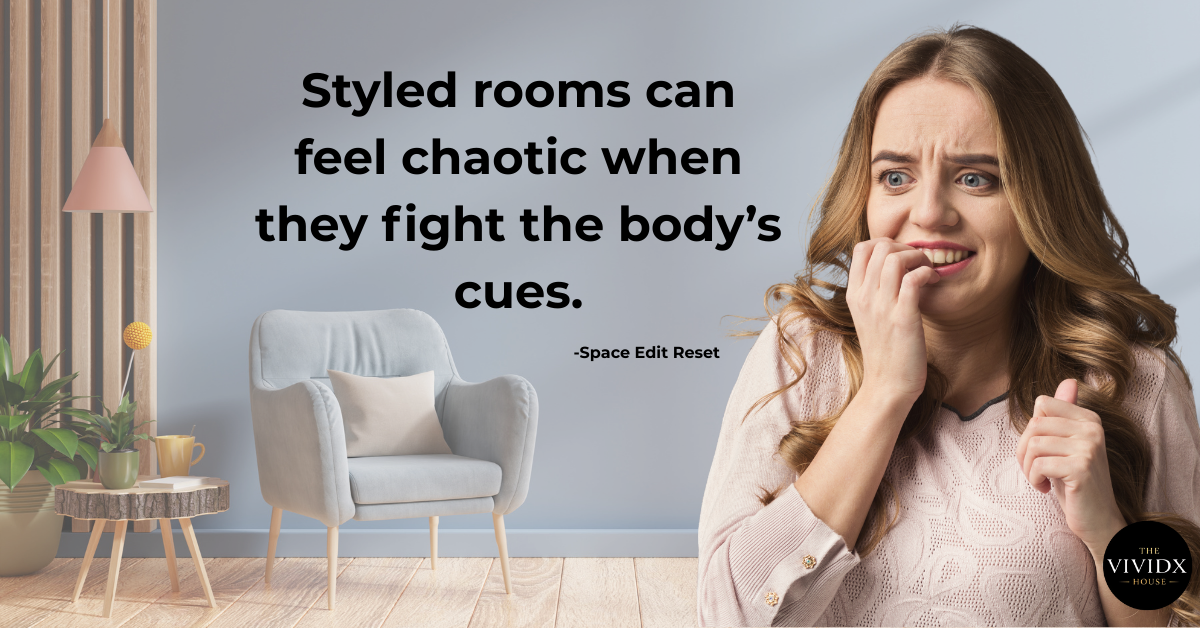
THE DIFFERENCE BETWEEN “STYLE” AND “STABILITY”
Style follows trends.
Stability follows the nervous system.
Clients often design their homes based on visual inspiration rather than how a space actually performs. The result is a mismatch between appearance and experience.
Consider these common patterns:
Pattern One: Aesthetic decisions that ignore circulation
A client centers a large rug under the sofa because it looks great in a photo, but the placement narrows every walkway in the room. Each time they move through the space, their body adjusts. Over time, the micro-tension becomes emotional tension.
Pattern Two: Décor layers that overwhelm the eye
Trend-forward homes often layer decorative items: trays, vases, sculptures, stacked books, textiles, candles. These items look intentional, but when grouped together they create visual weight the body must constantly process.
Pattern Three: Furnishings chosen for images rather than for physiology
A stunning sofa chosen for its style might be too deep or too low. Clients sink into it and instantly lose postural support. Their breath changes. Their attention scatters. They blame stress. The real issue is architecture.
Style does not tell the body how to feel.
Function does.
WHY THIS HAPPENS SO OFTEN
Clients mistakenly believe that a beautiful space equals a supportive space.
They try to follow what they see online.
But social media homes are designed for photographs, not for nervous-system alignment.
Styled spaces often include:
bold contrast
high object count
multiple visual focal points
strong lines and angles
exaggerated symmetry
decorative complexity
These features perform well in pictures.
But for clients who are sensitive, overwhelmed, recovering, or simply functioning like most modern adults, they create strain.
A room designed for aesthetics may feel like a performance, not like support.
THE NERVOUS SYSTEM DOES NOT READ BEAUTY. IT READS LOAD.
The body evaluates a room based on:
how many decisions it must make
how many objects it must categorize
how evenly space is distributed
how much visual weight sits in the field of view
how the furniture influences posture
how many micro-adjustments movement requires
how predictable or unpredictable the environment feels
A “perfectly styled” home can overwhelm because it demands more processing per second than the client realizes.
Clean does not equal calm.
Pretty does not equal stable.
Styled does not equal supportive.
THE SPACE EDIT RESET™ CLARIFIES THE DIFFERENCE
The Reset reveals what the eye has been missing and what the body has been trying to communicate.
Step One: Clear Surfaces
This removes the decorative noise layered into the space. Many clients feel relief before they move anything else. They finally see the room’s architecture without distractions.
Step Two: Observe from Three Vantage Points
This is where the truth becomes unavoidable.
From one spot, the room might look gorgeous.
From another, it feels chaotic.
Clients see:
the crowded bookshelf that looked “styled”
the oversized coffee table that compresses circulation
the decorative items that create visual static
the mismatched heights that pull the eyes in multiple directions
the rug placement that alters posture
They suddenly understand why the room feels busier than it looks.
Step Three: Emotional Inventory
Clients describe their beautifully styled rooms using words they never expect:
“loud”
“sharp”
“tight”
“busy”
“wired”
These terms are not about aesthetics.
They are about nervous-system interpretation.
The Room Reset clarifies whether the décor is enhancing the space or competing with it.
Steps Four through Six: Anchor, Reset, Elevate, Confirm
These steps turn the room into an ally.
They establish function, reduce friction, and build an environment that supports the client’s internal state rather than undermining it.
A space can be both beautiful and regulating.
But beauty without structure creates chaos.
REAL EXAMPLES OF BEAUTIFUL ROOMS THAT FELT TERRIBLE
Example One: The picture-perfect living room that created anxiety
A client styled her living room like a magazine. Neutral palette. Modern shapes. Intentional décor. The problem was the object density. Every surface held something decorative.
When she went through the Reset, she realized her eyes never rested. The room was visually crisp but psychologically demanding.
Example Two: The bedroom designed from Pinterest boards
A client chose a wall of artwork that she saw online. It looked curated and elegant. Yet she described feeling restless every night.
Through the Reset, she learned the artwork created multiple focal points directly across from her bed. Her system stayed alert because the visual field was too active.
Example Three: The dining room chosen for aesthetic impact
Another client followed a trend of large, sculptural centerpieces and oversized chairs. The look was stylish. But the chairs were heavy and difficult to move, making everyday use physically stressful.
The room impressed others but irritated her nervous system.
These patterns repeat across homes regardless of price point.
The issue is not taste.
The issue is function.
WHY THERAPISTS SHOULD CARE ABOUT THIS
Your clients practice regulation, grounding, and emotional resilience.
But when they go home to a space designed for appearance rather than experience, their progress becomes inconsistent.
A styled-but-strained room can:
increase emotional load
disrupt regulation
amplify overwhelm
trigger irritability
decrease tolerance
limit rest
mimic anxiety symptoms
Therapists see emotional patterns.
Designers see environmental patterns.
Both matter equally.
If the environment contradicts the client’s internal work, the home quietly unravels the stability they are trying to build.
WHAT CLIENTS CAN DO THIS WEEK TO REDUCE STYLED CHAOS
Here are simple, powerful steps that bridge design and nervous-system alignment:
1. Remove half of the decorative items from one surface.
Most styled spaces contain twice the number of objects needed.
2. Sit in three different vantage points and ask, “Where does my eye stop?”
If the eye never stops, the nervous system cannot settle.
3. Identify one decorative element that adds visual weight without adding function.
This usually becomes the item that creates internal chaos.
4. Photograph the room before and after clearing a single area.
Clients often see more imbalance in photos than in real life.
These steps help clients understand the difference between a space that looks good and a space that works well.
THE FUTURE OF DESIGN IS NERVOUS-SYSTEM LED
As clients become more self-aware, the old design metric — “Does it look good?” — is losing relevance.
The real question is:
Does the space support the person who lives there?
A beautiful room can feel terrible.
A simple room can feel incredible.
The difference is not style.
It is performance.
The Space Edit Reset™ gives clients the structure to build rooms that meet both needs: visually strong and physiologically supportive.
A home can be stunning and stabilizing.
But not if beauty is the only goal.
Is their space working for them or against them?