
When a Room Trains the Nervous System: The Environmental Patterns Your Clients Can’t Override
Therapists often work with clients who understand regulation techniques but struggle to apply them in daily life. They practice grounding in your office, feel steady during sessions, and describe moments of clarity. Then they return home and everything unravels.
Nothing “bad” happens at home.
No conflict.
No crisis.
No triggering conversation.
Yet something in their body shifts the moment they walk into certain rooms.
From a design perspective, this pattern is predictable.
The room is training the nervous system just as much as any habit, routine, or posture.
This concept aligns closely with Irene Lyon’s teaching: the body responds to cues long before the mind labels them. A home full of conflicting signals, outdated patterns, or structural friction alters how the system behaves.
The client is not failing their regulation tools.
Their environment is running a program the body has learned to follow.
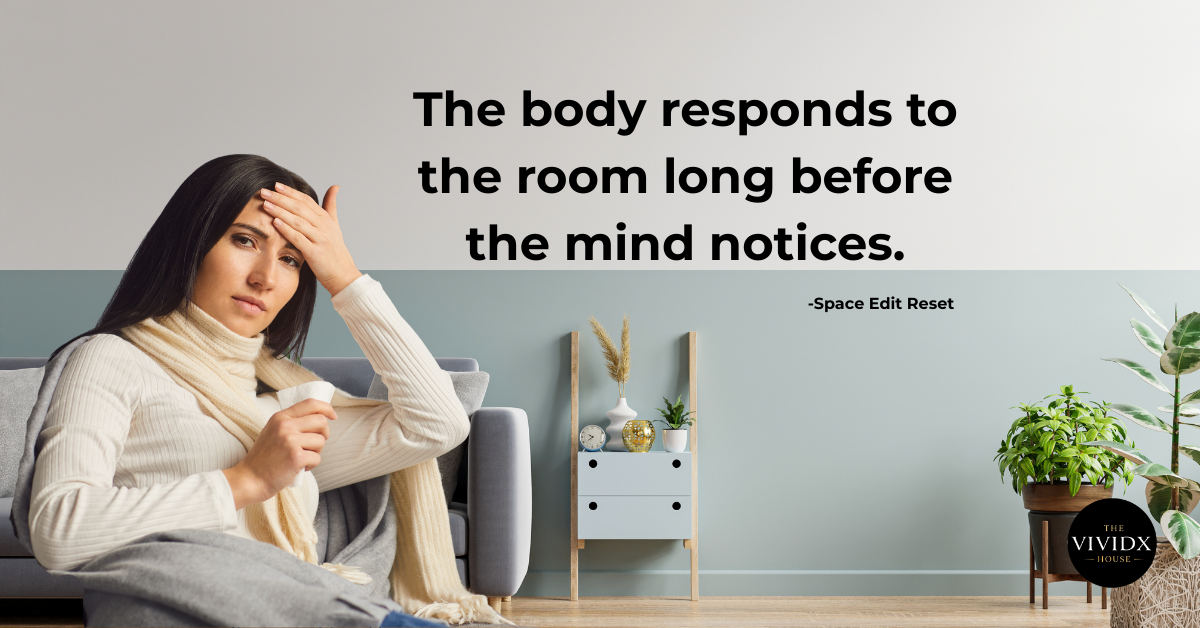
THE ROOM AS A SOMATIC TEACHER
Clients interpret their environment somatically, not intellectually.
Before they think, they sense.
Before they decide, they react.
When I walk through a home, I watch clients respond to the room the way a body responds to an old story:
a narrowed hallway tightens their shoulders
a crowded surface increases cognitive load
mismatched seating height compresses their torso
furniture that blocks circulation creates micro-bracing
a dark corner sends subtle signals to stay alert
These reactions happen instantly.
No one chooses them.
The room cues them.
This is why clients often feel unease, agitation, or low-level tension even in “nice” rooms. The body recognizes what the mind overlooks.
A room becomes a somatic teacher.
It shapes breath, posture, readiness, orientation, and attention.
For clients doing regulation work, this creates a mismatch. Their body practices one state in therapy and another state at home.
THE THREE ENVIRONMENTAL PATTERNS THAT DERAIL REGULATION
Across hundreds of homes, I see the same categories of environmental stress that align with nervous-system behavior:
1. Spaces designed for former survival modes
Clients often arrange rooms during a stressful season of life, then never update them.
The environment continues to reflect:
hypervigilance
burnout
depletion
urgency
emotional compression
Even when the client has healed internally, the room keeps holding the posture of their past experience.
2. Visual environments that demand constant micro-processing
Clients try to regulate while sitting in rooms filled with:
object clusters
scattered categories
mixed heights
busy décor
open storage
The nervous system interprets these details as tasks.
Regulation cannot coexist with constant scanning.
3. Physical layouts that compromise breath and posture
Furniture scale and placement determine how the body organizes itself.
Rooms that work against natural posture lead to:
collapsed ribcage
restricted breath
forward-leaning vigilance
compressed diaphragm
tension across the neck and shoulders
Clients attempt to regulate while sitting in positions that contradict the state they are trying to achieve.
This is not lack of skill.
This is environmental contradiction.
THE SPACE EDIT RESET™ AS A SOMATIC ALIGNMENT TOOL
The Space Edit Reset™ system intersects perfectly with somatic work because it begins with the first principle of regulation:
See what is happening before taking action.
The Reset starts with clearing surfaces to reduce visual noise.
This step is less about aesthetics and more about removing the interference that keeps the body in a reactive state.
When clients remove the excess and observe the architecture beneath, their system receives a cleaner, quieter field of information.
Next, clients sit in three vantage points.
This is the somatic breakthrough.
They notice what their body has been responding to subconsciously:
imbalance
compression
crowding
outdated emotional markers
visually demanding corners
circulation patterns that keep them ready to move
Each seat reveals a different environmental truth.
Clients often describe these realizations in physical terms:
“This corner feels tight.”
“My chest feels low here.”
“My shoulders lift when I face that wall.”
“This side feels calmer.”
They are not talking about décor.
They are talking about the body.
The Reset gives them structure so these reactions finally make sense.
REAL EXAMPLES OF HOW ROOMS TRAIN THE BODY
Example One: The living room that cued readiness
A client practiced grounding techniques daily but reported feeling “keyed up” every time she entered her living room. When she went through the Reset steps, she noticed her sofa faced a walkway with frequent movement. Her body stayed in orientation mode without her realizing it.
By shifting her seating angle and clearing the nearest surface, her system stopped preparing for interruption.
Example Two: The bedroom arranged for vigilance
Another client described waking up tired despite sleeping in a neat, calm room. Through the Reset, she discovered her bed faced a tall, crowded dresser that created a sense of looming pressure. The body interpreted the vertical weight as a cue to stay alert.
After clearing the surface and shifting the dresser’s position slightly, the room felt noticeably lighter.
Example Three: The home office that compressed posture
A client’s desk was pushed into a corner with shelves on both sides. The visual density made the space feel narrow, and her shoulders lifted every time she sat down. She believed the problem was work stress.
The Reset revealed the environment itself was inducing micro-bracing. Once she opened the sightlines and cleared one shelf, her posture changed naturally.
These examples are not emotional.
They are architectural.
The environment was training the nervous system in specific directions.
WHY SOMATIC WORK NEEDS ENVIRONMENTAL ALIGNMENT
Clients can regulate in your office because the space supports the state they are practicing.
But their home may be teaching their body the opposite:
urgency
alertness
fragmentation
indecision
compression
Somatic work relies on repetition and consistency.
The home must reinforce the desired state, not undo it.
When environment aligns with somatic principles:
the body shifts faster
grounding becomes predictable
stress responses decline
routines stabilize
emotional load decreases
clients feel more capable
When environment contradicts somatic principles:
clients regress between sessions
grounding becomes inconsistent
focus collapses quickly
repetitive patterns return
clients blame themselves
But the cause is architectural, not personal.
WHAT CLIENTS CAN DO THIS WEEK
Here are actionable steps that complement Irene Lyon’s nervous-system approach while staying within your design framework:
1. Clear the main surface in the room where they feel the most activation.
Clearing reduces visual interruption and gives the body a place to rest its attention.
2. Sit in three different vantage points and note physical sensations.
This reveals environmental triggers the mind has not articulated.
3. Identify one outdated item that represents a past version of themselves.
Removing it breaks an environmental link to an old pattern.
4. Walk the circulation path and observe where the body tightens.
Narrow paths, sharp edges, and crowding reveal architectural stress points.
These steps help clients align their environment with the somatic work they are already doing.
THE HOME AS AN EXTENSION OF SOMATIC WORK
A home cannot regulate a client.
But it can remove the friction that keeps them from regulating.
A room can cue readiness.
A room can cue calm.
A room can reinforce old patterns.
A room can expand new ones.
When the environment aligns with the body, clients experience regulation on a daily basis.
When the environment works against the body, clients feel unstable even with strong therapeutic skills.
The Space Edit Reset™ gives them a structured pathway to create alignment between their internal world and the place they live every day.
Is their space working for them or against them?