
The Role of the Physical Environment in Trauma Recovery
Clients healing from trauma often describe discomfort inside their home that feels strangely persistent. They walk into a room and sense heaviness. They sit on their own sofa yet remain on alert. They keep the space clean, keep the décor updated, and keep trying to make it “feel better,” but something in their body refuses to soften.
This tension is not a character flaw. It is not resistance.
It is the home holding patterns the nervous system recognizes instantly.
A space interacts with trauma in subtle but powerful ways.
Rooms carry memory.
Objects carry identity.
Layouts carry old rhythms of living.
Even when a client has done significant internal work, their home may still reflect a version of themselves shaped by survival, vigilance, or depleted capacity. They try to recover inside an environment that silently reinforces what they are trying to leave behind.
This is where design becomes part of the healing ecosystem.
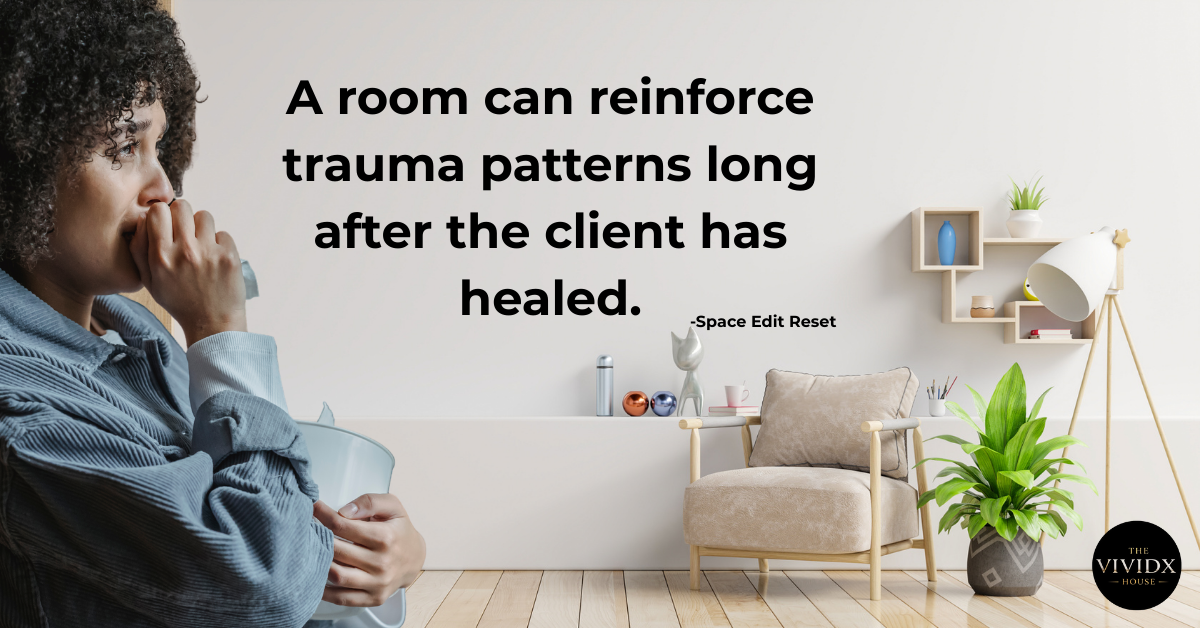
HOW TRAUMA SHOWS UP IN A ROOM
The home of a trauma survivor often holds physical characteristics that mirror their past experiences, even when they have changed internally.
Three patterns appear repeatedly:
1. Rooms arranged for vigilance rather than rest
Clients often keep furniture positioned toward doorways, hallways, or windows they feel responsible for monitoring. Seating is set up to “watch the room,” even in spaces meant for relaxation. The body stays slightly forward, ready to respond.
2. Surfaces filled with objects tied to old stories
Shelves and tables hold items kept out of obligation, not support. Each item is neutral by itself, but collectively they hold emotional residue. The body recognizes the weight long before the mind labels it.
3. Outdated identity markers throughout the home
Many clients retain décor, photos, furnishings, and layouts that matched their life during the hardest years. The home becomes a time capsule that reinforces who they were when they were trying to endure.
These patterns are not intentional.
They are the natural result of living in a space during a difficult season.
But if the home stays the same while the client grows and changes, the environment pulls them back into an old posture.
WHY CLEAN AND DECORATED SPACES STILL FEEL “HEAVY”
Clients often assume the solution is more decorating. They update pillows, add artwork, buy new lamps, and rearrange the sofa. When the heaviness persists, they blame themselves.
“I guess this is just how I feel.”
“I should be over this by now.”
“I don’t know why my home still feels wrong.”
The truth is simpler.
They are decorating over a structural pattern built during survival.
Trauma changes how a person interprets space.
A room that once provided comfort now carries cues the nervous system associates with distress.
Even neutral furniture feels loaded.
Even calm colors feel flat.
Even organized surfaces feel unsettled.
The environment holds a version of the client that no longer exists, and the body senses the mismatch immediately.
This is why trauma recovery often accelerates when the home shifts.
Not because décor heals trauma, but because alignment supports regulation.
HOW THE SPACE EDIT RESET™ MEETS THIS NEED
The Space Edit Reset™ gives trauma survivors a way to rewrite the physical environment without overwhelming them.
It is structured.
It is contained.
It is sequential.
And it emphasizes observation before action.
Clients begin with a simple step: clearing surfaces.
This step reveals what the room has been holding. Without the visual noise, the true architecture emerges. Clients see whether the room is arranged for rest or for monitoring. They see how objects influence them. They see what has been asking for release.
Next, clients sit in different vantage points.
This step is essential for trauma recovery, because each seat reveals a different layer of embodied memory. A chair by the window may feel exposed. A corner may feel compressed. A bed may feel emotionally crowded. A dining table may feel tense because it still reflects past dynamics.
Clients often describe this experience as “finally seeing what my body has been trying to tell me.”
Then comes the inventory stage.
Clients identify what feels supportive, neutral, or heavy.
They do this based on function, not sentiment.
What belongs?
What no longer aligns with who they are today?
What deserves to move to a new place or leave the home entirely?
These steps meet trauma survivors exactly where they are.
They give them a sense of control without forcing big decisions.
They help the room shift gradually, gently, and without emotional strain.
WHAT I SEE WHEN A ROOM HOLDS TRAUMA
Over the years, I have seen patterns repeat across hundreds of homes.
Not because trauma looks the same for everyone, but because architecture responds predictably to lived experience.
A few examples illustrate how clear the pattern becomes once the Reset begins:
Example One: The bedroom that felt “tight”
A client had a beautifully decorated bedroom that still felt tense to her. The furniture was placed symmetrically, the color palette was calm, and the surfaces were spotless. Yet she avoided the room at night and could not settle when she was in it.
Once she completed Step One and Step Two of the Space Edit Reset™, she discovered something important. The bed was positioned in a way that mirrored a layout from an older home where she experienced high stress. The placement itself felt loaded, even though she had never consciously noticed.
When she shifted how she approached the room, the tension eased before a single piece of furniture moved.
Her body had recognized the layout long before she named it.
Example Two: The living room arranged for past dynamics
Another client felt emotionally drained in her living room despite keeping it clean and bright. When she sat in the chair she rarely used, the room looked completely different than it did from the sofa. She could see that the seating was arranged around relational patterns she no longer lived with. The arrangement held a hierarchy, a posture, and a dynamic that kept her on edge.
When she saw the room from this new angle, she said, “This is the version of me I’m trying to grow out of.”
The space was not wrong.
It was outdated.
And her body knew it.
Example Three: A kitchen that triggered decision fatigue
Clients who have lived through years of survival often have kitchens filled with items accumulated for practicality, not support. Even if the counters are clean, the visual load of open storage, mismatched items, and layered objects increases cognitive load. One client described her kitchen as “loud,” even though it was physically quiet.
Once she completed the Reset steps, she realized she had been making hundreds of micro-decisions every time she entered the room. The kitchen had been working against her attention and capacity. As soon as surfaces cleared and items found appropriate places, her stress level dropped without any major redesign.
These stories repeat across homes and lives.
The body remembers.
The room reflects.
The Reset reveals.
WHY TRAUMA RECOVERY NEEDS ENVIRONMENTAL ALIGNMENT
A trauma survivor can do profound internal work yet still live inside an environment built during distress. When the room stays frozen in the past, the client feels pulled in two directions. They grow forward in therapy, but the home tethers them to an old version of themselves.
This causes:
emotional fatigue
restlessness
difficulty relaxing
misinterpreted signals
a sense of “something is wrong”
frustration without clarity
When the environment starts supporting the newer version of the client, their nervous system responds. Their posture shifts. Their tolerance expands. Their mood stabilizes faster. Their capacity increases.
The home stops reinforcing hypervigilance and begins supporting regulation.
WHAT CLIENTS CAN DO THIS WEEK
Here are simple, powerful starting points for trauma survivors:
1. Choose one room only.
Wide-scope projects increase overwhelm.
A single room gives them a defined container.
2. Clear the primary surface.
One table. One dresser. One countertop.
This removes visual interference and reveals the real shape of the room.
3. Sit in three vantage points and write three words for each.
The body often tells the truth before the mind does.
These steps bring clarity without triggering emotional overload.
The room begins to reflect who the client is now, not who they were.
THE HOME AS AN ALLY IN HEALING
A home cannot undo trauma.
But it can either reinforce the past or support the future.
When a room holds emotional residue, clients feel heavier.
When a room aligns with their present identity, they feel grounded.
Trauma recovery asks clients to reshape their internal world.
The Space Edit Reset™ helps them reshape the external world so both move in the same direction.
Is their space working for them or against them?