
ADHD, Distraction Patterns, and the Built Environment
Clients with ADHD often believe their biggest struggle happens internally. They describe racing thoughts, difficulty sustaining attention, constant redirection, and the familiar cycle of starting and abandoning tasks. They assume these challenges come entirely from within. Yet when I walk into their homes, a different story emerges.
The environment is amplifying the very symptoms they are trying to manage.
ADHD is influenced by sensory input, visual cues, object quantity, and how the body navigates a room. When a space is overloaded, inconsistent, or full of competing signals, the client’s attention scatters long before they begin a task. The room demands more processing than their system has capacity for.
Polyvagal specialists, somatic practitioners, and ADHD clinicians understand this intuitively. The nervous system interprets every detail of a room as information. ADHD makes that information louder, sharper, and harder to filter out.
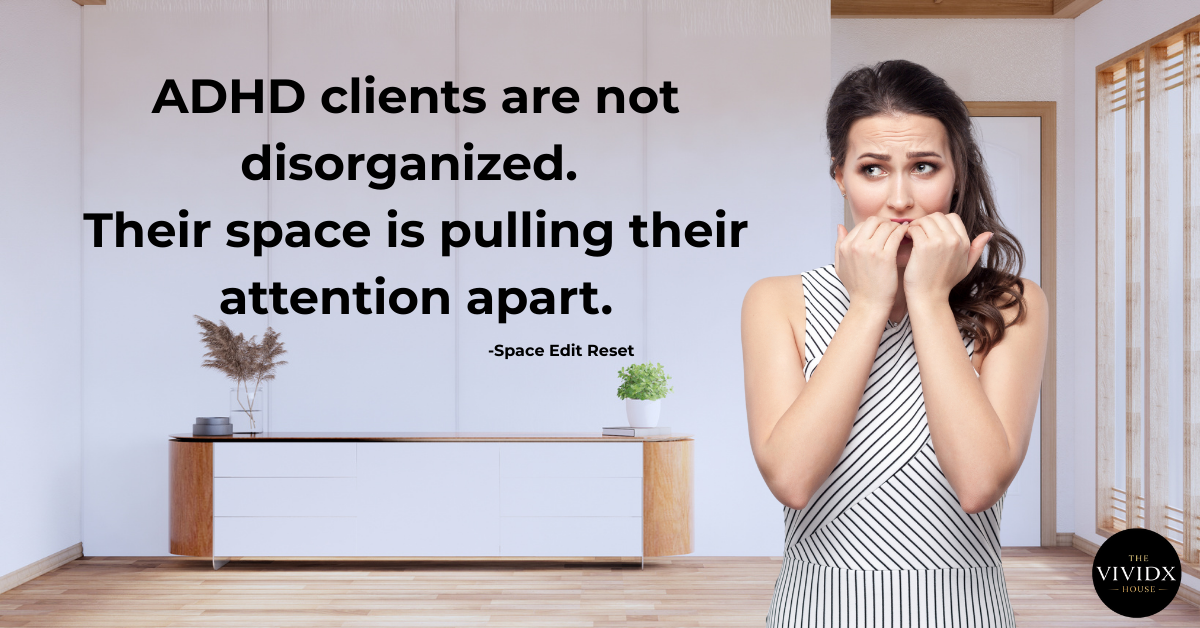
In a home that works against them, clients are not “distracted.”
They are responding to an environment that pulls their attention in ten different directions at once.
HOW ADHD SHOWS UP INSIDE A ROOM
There are predictable, physical patterns in the homes of clients with ADHD. These patterns reveal how closely the environment and the mind are intertwined.
1. Object scattering across all visible surfaces
Counters, tables, nightstands, and desks become landing pads for unfinished tasks. A single surface can hold dozens of independent cues, and each one pulls the mind toward a different micro-task. This creates endless internal redirection.
2. High visual contrast and too many categories in view
Open shelves, baskets, bins, and organizers that expose everything at once amplify distraction. Even well-organized items still demand categorization every time the client walks by.
3. Furniture positioned in ways that disrupt focus
A desk that faces a busy part of the house. A sofa pointed toward a walkway. A dining table positioned near the entry. Each placement invites interruption. For someone with ADHD, the body tracks movement instantly.
4. Multiple projects competing for attention within one sightline
Craft supplies on the dining table. A laundry basket in the corner. A stack of papers on the sofa. The brain leaps from one unfinished item to the next, creating a loop of partial engagement.
5. Lighting that creates sharp highlights and shadows
Many ADHD clients describe discomfort without knowing why. Strong overhead lighting, dark corners, and inconsistent brightness provoke constant micro-adjustment.
These elements create a cognitive environment that is louder than the client’s intentions. The mind does not struggle because it is unfocused. It struggles because the space provides too many cues at once.
THE MISINTERPRETATION: “I’M DISORGANIZED”
Clients with ADHD often blame themselves. They spend years internalizing a narrative of disorder:
“I can’t keep up.”
“I get distracted too easily.”
“I can’t finish anything.”
“I don’t know why this is so hard for me.”
But the moment the room is evaluated from a design perspective, a different truth appears.
Their home is designed to break their focus.
Every sightline contains tasks.
Every surface contains reminders.
Every room contains overstimulation.
ADHD magnifies what the room is already doing.
Clients are not failing their environment.
Their environment is failing them.
THE SPACE EDIT RESET™: A SYSTEM THAT STABILIZES ATTENTION
The Space Edit Reset™ gives ADHD clients a way to create structure without relying on self-discipline alone. It gives their environment a role in supporting their attention.
The Reset begins with clearing surfaces.
This single step reduces competing cues instantly. It reveals what the room is actually saying to the client. When the visual noise disappears, the mind stops tracking so many categories at once.
Next, clients sit in three vantage points. This step is critical for ADHD because each position reveals a new layer of distraction:
a pile in the corner they forgot about
a shelf filled with too many categories
a walkway that catches movement in their peripheral vision
a countertop with multiple unfinished projects
a cluster of décor items that create visual “buzz”
From these seats, clients finally understand why they lose focus in certain parts of the room. The space itself is teaching them how their attention is being pulled.
The emotional inventory step brings language. Clients name what feels manageable and what feels overwhelming. They identify which items support focus and which items derail it. They begin to see that their attention is not failing but responding.
The final steps of the Reset stabilize function, reduce friction, and create a room that supports consistent focus.
REAL EXAMPLES OF ENVIRONMENT-INDUCED DISTRACTION
Example One: The desk that faced too much life
A client struggled to complete work from home. Her desk faced the kitchen, where she could see dishes, the refrigerator, and the back door. Every object was a task. Every movement was a cue. Her focus broke constantly.
Once she applied the Reset steps, she realized the desk placement made sustained attention impossible. She shifted the desk to face a quieter wall, cleared the nearest surface, and created a visual anchor. Her capacity increased within one afternoon.
Example Two: The living room with scattered categories
Another client felt constantly overstimulated. Her living room had toys on one side, mail on the coffee table, a half-finished project on the console, and decorative items on every surface. Even though everything was organized, the variety pulled her attention in five directions.
After the Reset, she grouped categories, removed excessive visual contrast, and simplified her sightline. She reported feeling calmer in the same room without any major redesign.
Example Three: The bedroom that became an accidental task zone
A client with ADHD struggled to fall asleep because her bedroom contained stacks of folded laundry, fitness equipment, and books she intended to read. The room was a collection of unfinished missions. Her mind activated the moment she entered.
Through the Reset, she discovered that removing task-related objects from her sightline created immediate restfulness. Her nervous system registered the room differently the first night the surfaces were empty.
None of these examples required adding storage or buying décor.
They required understanding how ADHD interacts with the built environment.
WHY ADHD WORK NEEDS ENVIRONMENTAL SUPPORT
Clinical work teaches strategies for attention, impulse control, planning, and emotional balance. But clients practice these skills inside homes that often contradict them.
When the environment supports regulation:
attention stabilizes
tasks become clearer
routines stick
stress decreases
executive function increases
clients feel capable rather than scattered
When the environment disrupts regulation:
clients become inconsistent
systems break down
overwhelm increases
unfinished tasks accumulate
the emotional load becomes heavier
ADHD is not just neurological.
It is architectural.
The home must be built to reduce friction, not intensify it.
WHAT CLIENTS CAN DO THIS WEEK
Here are the foundational steps ADHD clients can apply immediately:
1. Clear a single surface in the room where they struggle most.
This reduces competing cues and creates a visual anchor.
2. Sit in three different spots and write down the first three things their eyes land on.
These reveal the true sources of distraction.
3. Put items unrelated to the room’s function into a “belongs elsewhere” bin to deliver later.
This reduces category conflict.
4. Photograph the space from the four corners.
ADHD clients often see patterns in photos that they cannot see in real time.
These steps give clients clarity, not complexity.
They stabilize the visual field so the mind can focus without working against the room.
THE HOME AS A PARTNER IN ADHD SUPPORT
ADHD is not solved by décor.
It is supported by design.
A home can pull attention apart.
A home can calm attention.
A home can reinforce the very skills clients are learning in therapy.
The Space Edit Reset™ gives clients a structured system that aligns their environment with their neurological needs.
When the room becomes a partner instead of a source of disruption, clients can focus with less strain and more confidence.
Is their space working for them or against them?