
How to Make a Small Room Feel Bigger Without Getting Rid of Everything
You walk into a small room and instantly feel the limits. The walls feel closer. The walkway feels tight. The furniture feels heavier. You want the room to feel bigger, but you do not want to live like a minimalist or throw out half of what you own. You want the room to work without stripping it down.
A small room does not need less stuff.
A small room needs better structure.
When the structure is aligned, even the smallest rooms can feel open, calm, and surprisingly spacious.
Most small rooms feel cramped because the layout blocks the natural flow
Homeowners blame clutter or the size of the space, but size is rarely the real issue.
Small rooms feel cramped when:
• the anchor is misplaced
• the walkway is tight
• the furniture is scaled wrong
• the visual weight is heavy
• the layout works against movement
Fix these and the room expands without removing everything.
1. Pull furniture away from the walls
This is the opposite of what most people do, but it is the first move designers make.
When everything is pushed to the perimeter, the walls feel closer and the room feels boxed in.
Pull the sofa forward two inches.
Move the chair slightly inward.
Create a defined seating zone instead of a wide empty center.
The room opens instantly.
2. Fix the walkway first
Small rooms often feel cramped because the walkway is fighting the layout.
Even a narrow path needs a clean, uninterrupted flow.
Ask yourself:
“Where does my body naturally want to walk?”
Arrange the room to support that line.
When the walkway works, the room feels twice as large.
3. Adjust the scale, not the quantity
Small rooms can hold multiple pieces as long as the scale is correct.
Examples:
• smaller nightstands instead of giant ones
• a wide rug that anchors the room instead of chopping it
• a coffee table that is proportional instead of oversized
When scale is right, the room feels spacious even with the same amount of furniture.
4. Balance the visual weight
Small rooms often feel heavy because one wall carries too much.
A large shelf on one side and a bare wall on the other creates imbalance.
To lighten the space:
• keep heavy items on the stable wall
• keep lighter items on the opposing wall
• avoid stacking too many objects in corners
Balance makes a small room feel open.
5. Define the purpose of the room
Small rooms often feel cramped because they try to do too much.
A room intended for resting ends up holding storage, work, hobbies, and overflow.
Choose one primary purpose.
Support it with the layout.
Let every other function be secondary.
When the purpose is clear, the room feels larger.
What not to do
Most people try to fix a small room by removing decor or buying more storage bins.
But if the structure is off, minimalism will not fix the tightness, and more storage will make the room heavier.
You do not need fewer things.
You need a smarter structure.
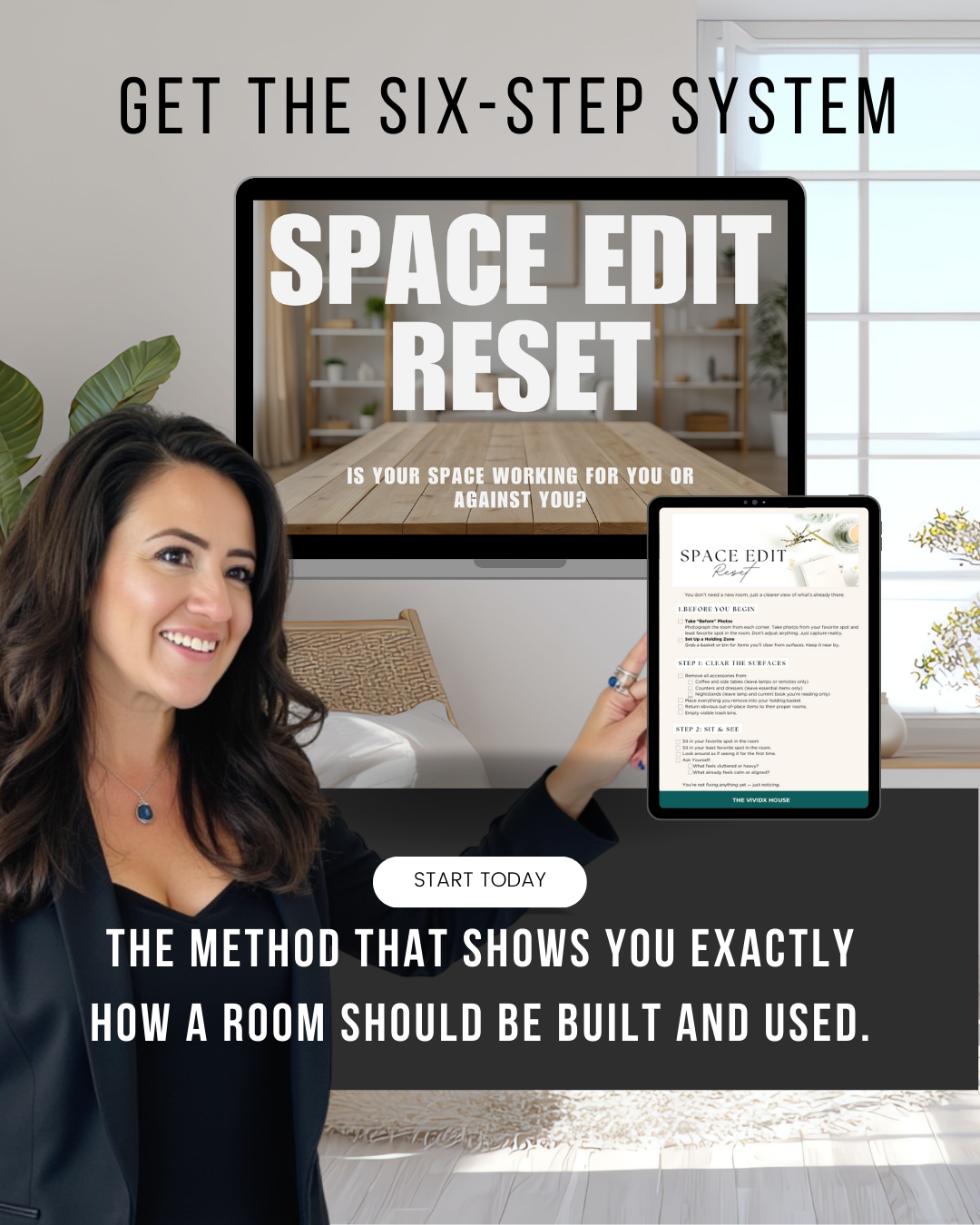
This is exactly what the Space Edit Reset™ solves
The Space Edit Reset™ teaches you how to evaluate a small room without defaulting to decluttering.
It shows you how to:
• observe the space from multiple angles
• clear surfaces so the structure is visible
• identify the true anchor
• reset the layout to maximize movement
• lighten the visual load without getting rid of meaningful pieces
Small rooms feel bigger when the structure supports your body, not when you remove everything.
Two simple moves to make any small room feel bigger today
1. Pull the anchor piece forward slightly
Move the sofa, bed, or main chair forward by two inches.
This single action breaks the boxed-in feeling and expands the space visually.
2. Clear one full wall for 24 hours
Take everything off one wall.
This reveals the true proportions of the room.
You will see where the imbalance lives and what needs to shift.
A real homeowner moment
A homeowner once told me her tiny guest room felt claustrophobic. She assumed she needed to clear everything out. But once we walked through the Reset sequence, the real issue became obvious.
The bed was pressed to the wall, and the walkway to the door was squeezed tightly against a dresser.
We pulled the bed forward slightly, shifted the dresser to the stable wall, and removed one item from the sightline.
Nothing was decluttered.
Nothing was removed.
The room felt twice as big.
She said, “I cannot believe we didn’t get rid of anything.”
Your next step
You do not need to empty a small room to make it feel spacious. You need the right structure. The Space Edit Reset™ teaches you how to transform the way a room performs so it finally feels open, functional, and grounded.
Apply these principles inside The Space Edit Reset™.
Is your space working for you or against you?
JOIN THE FACEBOOK GROUP: The Space Edit Reset Group
Why Does My Home Feel Heavy?
You walk into your home and feel a weight you cannot describe. The rooms look tidy. The furniture is fine. Nothing is technically wrong. But the space feels dense, loaded, or sluggish. You feel it in your body before you even notice anything visually.
A home feels heavy when the structure carries more weight than the architecture can support.
This is not about clutter.
This is not about decor.
This is about how the room holds visual and spatial weight.
A heavy home is a structural problem, not an emotional one
Your space feels heavy because something in the architecture is being overloaded.
Homes feel heavy when:
• the anchor is pulling the room in the wrong direction
• the furniture scale is too large
• the walls carry uneven weight
• the walkway is tight
• the surfaces hold tall or dense objects
• the sightlines are crowded
This weight shows up as a heaviness you cannot ignore.
Here are the real reasons your home feels heavy
1. The anchor is creating pressure instead of support
When the sofa, bed, or dining table is pressed against the wrong wall or pointed toward the wrong focal point, the entire room feels tense.
A misaligned anchor pushes weight in the wrong direction.
2. The furniture scale overwhelms the architecture
Even one oversized sectional or deep accent chair can make the entire room feel heavier.
Examples of scale creating heaviness:
• a sofa too long for the wall
• a tall dresser in a low ceiling room
• a rug too small for the seating zone
• a coffee table too narrow
Mismatched scale adds immediate weight.
3. The surfaces carry tall or bulky items
Tall lamps, thick books, stacked objects, or layered decor can make an entire wall feel dense.
Surface load determines whether the room feels light or heavy.
4. The walkway forces your body to adjust
If you have to angle your steps or squeeze around furniture, your home will feel heavy even when it is clean.
Your body interprets friction as weight.
5. The walls are visually unbalanced
One wall may carry too much art, furniture, or shelving.
Another wall may be completely bare.
This creates a visual imbalance that reads as heaviness.
6. The sightlines are overloaded
The first thing your eye sees determines how your home feels.
If your main sightline contains dense objects, stacked decor, or furniture that feels bulky, the entire home feels heavier.
Why cleaning will never fix a heavy-feeling home
Cleaning removes items.
Structure removes pressure.
You can tidy surfaces, fold blankets, and clear counters, but if the anchor is off or the walkway is tight, the home will still feel heavy.
The heaviness is coming from the architecture, not the items
This is why homeowners feel frustrated when they clean constantly but never feel relief.
They are treating a structural issue like a housekeeping issue.
This is exactly why the Space Edit Reset™ works
The Space Edit Reset™ teaches you how to identify structural weight, not just surface weight.
It shows you how to lighten a room without removing everything you own.
Inside the Reset, you learn how to:
• observe the room without noise
• clear surfaces to see weight distribution
• identify the correct anchor
• open circulation paths
• rebalance the walls
• return only the pieces that support the room
Once the structure is aligned, the heaviness dissolves.
Two simple tests that reveal the source of heaviness
1. Remove all items from one major surface
Choose a console, nightstand, or entry table.
Clear it completely.
Step back.
If your home feels lighter instantly, the heavy feeling was coming from surface load, not clutter.
2. Pull the anchor piece forward two inches
Move the sofa, bed, or dining table slightly forward.
This breaks the visual pressure against the wall and releases weight from the room.
Most homeowners feel an immediate shift.
A real homeowner moment
A homeowner once told me her home felt “heavy” even though she kept it spotless. She thought she needed to declutter. But when we applied the Reset, the issue was obvious.
Her sofa pressed tightly against the wall created a visual block.
The walkway curved awkwardly. The surfaces held tall lamps and layered objects.
We corrected the anchor, opened the walkway, and lightened the surfaces.
She didn’t know her home could feel this light without changing anything major.
Your next step
If your home feels heavy, the issue is not your belongings. It is the structure. The Space Edit Reset™ teaches you how to realign your rooms so your home feels open, balanced, and grounded again.
Apply these principles inside The Space Edit Reset™.
Is your space working for you or against you?
JOIN THE FACEBOOK GROUP: The Space Edit Reset Group