
Why Does My Home Feel Disconnected From Room to Room?
You walk from the living room to the hallway, then into the bedroom, and the feeling shifts in every direction. One room feels heavy. Another feels empty. Another feels tight. Another feels unfinished. Nothing feels cohesive. Nothing feels like part of the same home. Even though each room may look fine on its own, the entire house feels fragmented.
A home feels disconnected when the structure breaks from room to room.
This has nothing to do with matching decor or color palettes.
This is about the architectural rhythm of your home not working as a whole.
A disconnected home is a structural issue across multiple rooms
Your house feels disconnected when:
• the anchors point in conflicting directions
• the walkway changes pattern from room to room
• the scale shifts dramatically between spaces
• the sightlines fight each other
• the visual weight is uneven across the home
• the purpose of each room is unclear
Homes feel cohesive when the structure is consistent.
Homes feel disconnected when each room follows its own logic without supporting the next.
Here are the real reasons your home feels disconnected
1. The anchors are misaligned between rooms
Every room has a main anchor.
But if one anchor points north, another points west, and another points toward a random wall, the entire home feels disjointed.
Anchors should create a shared direction, not compete for dominance.
2. The walkway shifts in unpredictable ways
You may walk straight through one room, then curve sharply through another, then squeeze through a third.
Even if you do not consciously notice it, your body does.
Inconsistent circulation is one of the biggest causes of a home that feels disconnected.
3. The scale changes drastically between rooms
A large, deep sectional in the living room paired with tiny nightstands in the bedroom creates uneven weight across the home.
Your brain reads this as inconsistency.
Scale must feel related from room to room.
4. The walls carry weight unevenly
If one room has fully developed walls and another room is bare or underbuilt, the home feels visually lopsided.
A cohesive home distributes weight evenly.
5. There is no shared architectural rhythm
Rooms are not islands.
They relate to each other through:
• sightlines
• patterns of movement
• proportional relationships
• anchor alignment
When these are mismatched, the home loses unity.
6. The purpose of rooms overlaps or competes
A dining room trying to be a workspace.
A bedroom trying to be a storage area.
A living room trying to hold every function at once.
Purpose confusion creates home-wide disconnection.
Why decorating cannot fix a disconnected home
Most homeowners try to create flow by:
• matching colors
• repeating materials
• coordinating pillows
• buying similar decor
• adding plants everywhere
But decor cannot create architectural flow.
Structure creates flow.
Decor enhances what structure supports.
What creates a home that feels cohesive
A cohesive home has:
• anchors that align
• walkways that follow a natural pattern
• scale that stays proportional
• sightlines that feel intentional
• walls that are balanced across rooms
• purpose that is clear in every space
These elements create a steady rhythm that carries from room to room.
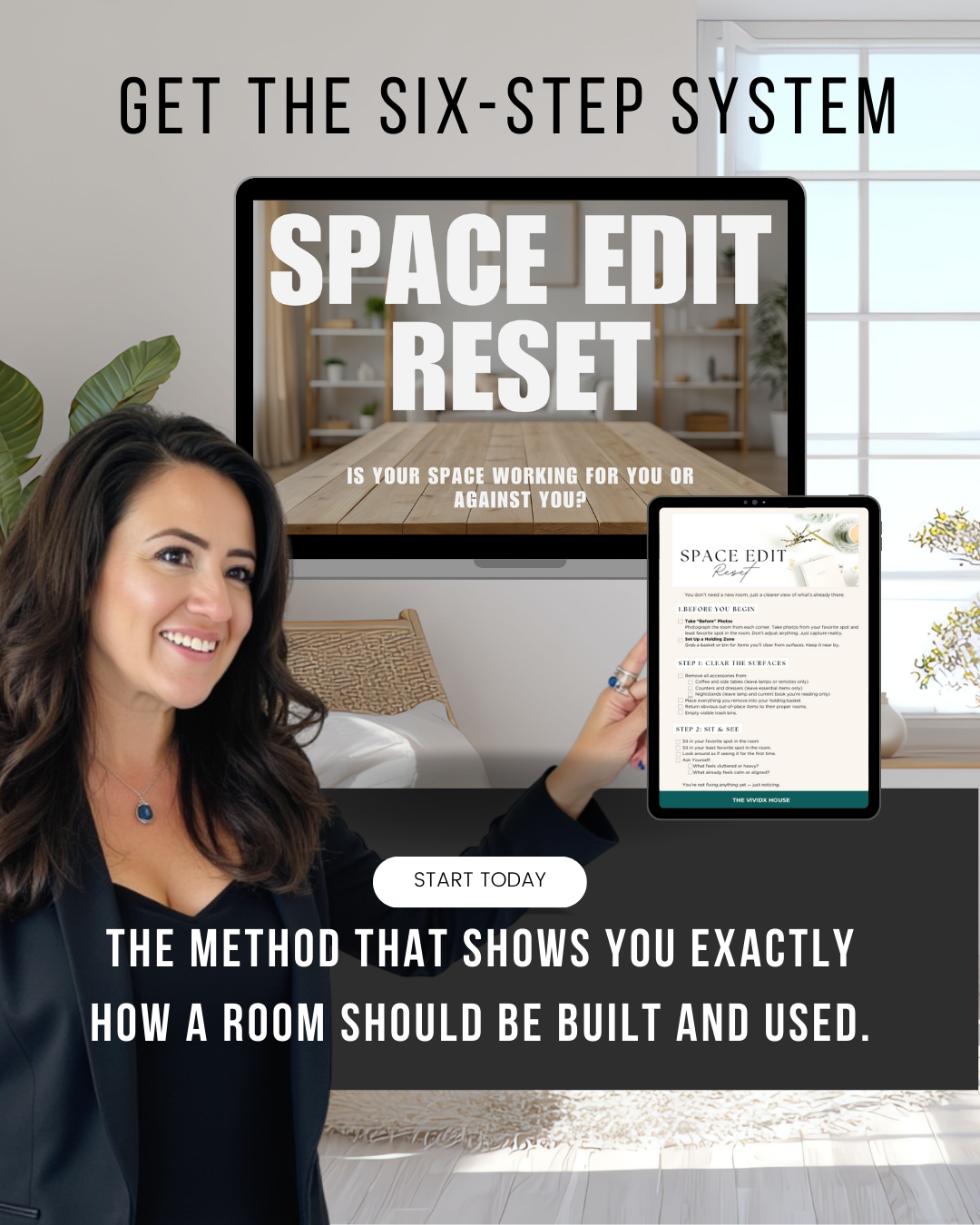
This is exactly why the Space Edit Reset™ works
The Space Edit Reset™ is not just a system for fixing individual rooms. It is a framework for aligning your entire home.
Inside the Reset, you learn how to:
• observe each room through the same structural lens
• clear visual noise so alignment becomes visible
• identify and correct competing anchors
• unify the circulation pattern
• balance visual weight across spaces
• rebuild each room so the flow feels consistent
Once the structure is aligned, the home feels cohesive even before you add decor.
Two tests that reveal why your home feels disconnected
1. Stand in the hallway and look into every visible room
If each room tells a different structural story, the home feels disconnected.
Look for:
• different anchor directions
• different scale patterns
• heavy walls next to empty walls
This reveals the break in flow.
2. Walk from the entry to the farthest room without stopping
Notice how many times you shift direction, adjust your body, or pause.
Each interruption signals a structural break that disrupts unity.
A real homeowner moment
A homeowner once told me her house felt like a collection of mismatched rooms. Each space looked fine alone, but the home felt chaotic as a whole.
Once we used the Reset, the issue became clear.
The anchors in every room pointed in different directions.
The walkways zigzagged.
The rooms did not support each other.
We realigned the anchors, adjusted the walkways, and balanced the walls.
The entire home felt unified without adding a single new item.
She finally felt like it was one home instead of eight separate rooms.
Your next step
If your home feels disconnected from room to room, the problem is not decor. It is structure. The Space Edit Reset™ teaches you how to align the entire home so every room works together instead of apart.
Apply these principles inside The Space Edit Reset™.
Is your space working for you or against you?
JOIN THE FACEBOOK GROUP: The Space Edit Reset Group