
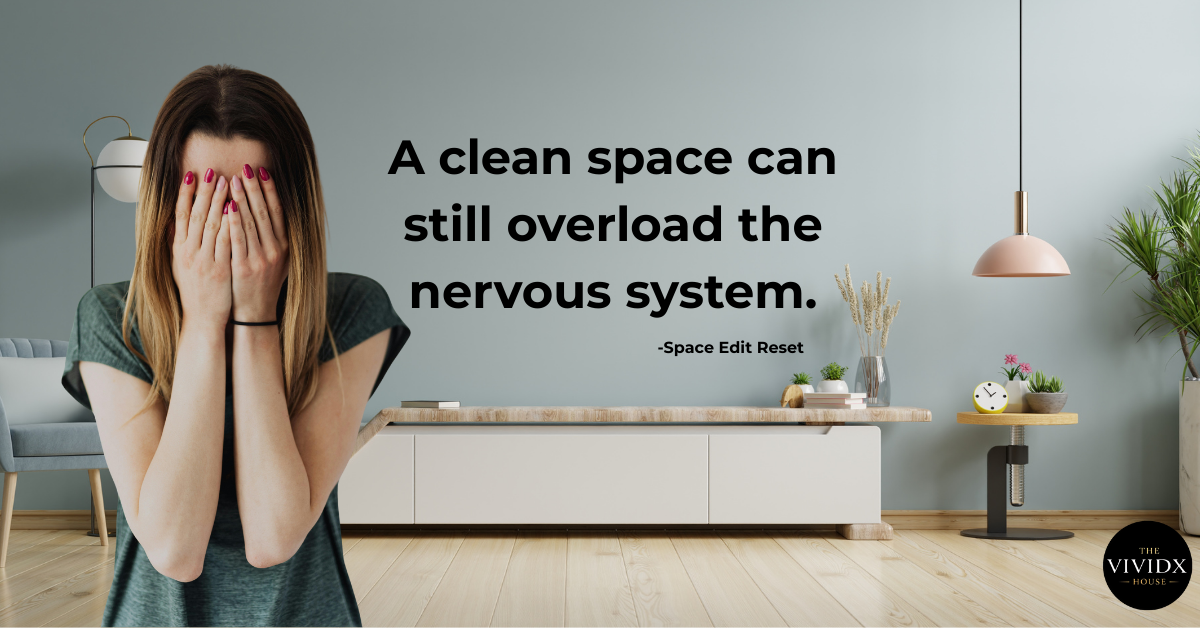
The Science of Visual Noise: Why a Clean Home Can Still Dysregulate the Nervous System
Therapists hear versions of this every day:
“My house is clean, but I still feel overwhelmed.”
“I put everything away, yet something still feels off.”
“I can’t figure out why this room makes me tense.”
Clients assume a space feels chaotic because it is messy. But from a design perspective, a room can be spotless and still create nervous-system strain. The issue is not clutter. The issue is visual noise — the constant stream of information the eyes must process even in a clean, decorated home.
The nervous system scans a room in less than a second.
It registers object density, contrast, height variation, material shifts, and circulation patterns long before the client consciously notices anything.
If the room sends too many signals at once, the system reacts just as strongly as it would in a visibly cluttered environment.
This is the hidden reason many clients feel activated in spaces that “should” feel calm.
Their home is visually loaded even when it is clean.
The Space Edit Reset™ reduces this load through structured environmental alignment. Therapists who understand visual noise can better help clients connect the dots between internal symptoms and external conditions.
WHAT EXACTLY IS VISUAL NOISE?
Visual noise is the accumulation of micro-stimuli in a room that demand processing.
Even if a client is not consciously looking at these details, their body is responding to them.
Visual noise includes:
too many small objects across surfaces
décor items with competing textures
open shelves filled with categories
furniture with strong vertical or horizontal lines
crowded art walls
busy patterns
overly bright or uneven lighting
mismatched scale
excessive visual contrast
Each element is harmless on its own.
Together, they create a landscape the nervous system experiences as fragmented.
A client’s eyes bounce from item to item without a place to rest. Their brain tries to organize what it sees. Their system works harder to filter out irrelevant data. This keeps them in low-level activation without ever identifying the cause.
Visual noise does not look chaotic.
It feels chaotic.
WHY CLEAN DOES NOT MEAN CALM
Clients often confuse cleanliness with stability.
They believe that if the home is orderly, they should feel grounded.
But the nervous system does not read “clean.”
It reads:
proportion
density
scale
rhythm
organization of height
sequencing of surfaces
distribution of objects
circulation paths
A room can be immaculately cleaned and still contain:
visual intensity
sensory overload
scattered focal points
abrupt transitions
architectural imbalance
Even well-styled homes can undermine regulation if the room lacks visual rest.
The nervous system wants coherence, not décor.
This is why some clients relax more in minimal hotel rooms than in their own beautifully decorated homes. The environment is simpler, clearer, and easier to process.
Homeowners often assume they need new décor to feel better.
In reality, they need fewer visual interruptions.
HOW VISUAL NOISE TRIGGERS THE NERVOUS SYSTEM
Visual noise impacts the body in three predictable ways:
1. It increases cognitive load.
Every object becomes a micro-task.
Every variation becomes a cue.
The mind tracks categories without realizing it.
2. It interrupts focus and rest.
The eyes cannot settle.
The system stays slightly alert.
Clients feel restless in rooms that overwhelm their visual field.
3. It creates emotional fatigue.
The body grows tired from constant processing.
Clients often describe this as “anguish,” “tension,” or “heaviness,” even when the room is spotless.
Therapists misattribute this sensation to emotional dysregulation.
Clients blame themselves for feeling stressed in a clean home.
But the cause is architectural.
THE SPACE EDIT RESET™ CLARIFIES WHAT THE NERVOUS SYSTEM HAS BEEN TRYING TO SAY
The Reset breaks visual noise into observable patterns.
Step One: Clear Surfaces
This step reveals the true architecture of the room.
When surfaces are clear, the nervous system stops scanning dozens of objects simultaneously. Clients feel relief within minutes.
Step Two: Observe from Three Vantage Points
This is where visual noise becomes undeniable.
From one seat, the room may look calm.
From another, everything feels loud.
Clients notice:
tall items that create visual pressure
clusters of small décor
abrupt transitions between furniture pieces
a crowded shelf they forgot about
the uncomfortable density of a particular corner
They finally understand why the room feels busier than it looks.
Step Three: Emotional Inventory
Clients describe the room’s visual noise in sensory terms:
“static”
“tight”
“busy”
“uneven”
“jumbled”
“sharp”
These descriptions reflect the body’s interpretation of the space.
The Reset gives them language for sensations that previously felt vague.
Steps Four through Six: Alignment
These steps help clients reduce unnecessary stimuli and create visual structure that supports regulation.
The result:
The nervous system stops working overtime.
The room becomes coherent.
The body relaxes naturally.
WHAT VISUAL NOISE LOOKS LIKE IN REAL HOMES
Here are real examples that therapists will instantly recognize in their clients:
Example One: A spotless kitchen that felt chaotic
A client kept her countertops clean but stored multiple categories in open view. Coffee supplies. Supplements. Mail. Small appliances. The surface was clear, but the visual field was crowded.
Once she cleared everything except one functional zone, she described the kitchen as “quiet” for the first time.
Example Two: A living room filled with décor that made the space visually “loud”
A client’s living room had shelves decorated with varied objects, each intentional and beautiful. Yet her system responded with agitation. Too many visual categories created a sense of noise even though everything was styled.
When she simplified the shelves, her body eased immediately.
Example Three: A bedroom with competing focal points
A client struggled to fall asleep even in a clean room. The problem was not clutter. It was visual intensity. The artwork, lamps, pillows, and decorative items pulled the eye in five directions.
Once the Reset clarified the architecture, she removed two focal points and felt the room settle.
The nervous system responds to architecture, not aesthetics.
WHY THIS MATTERS FOR THERAPISTS
Therapists often see clients progress in session only to lose momentum at home.
Visual noise is one of the most common reasons why.
A visually noisy room:
accelerates overwhelm
disrupts regulation
lowers tolerance
increases irritability
reduces emotional capacity
keeps the system in readiness mode
Clients try to regulate in environments that contradict the state they’re practicing.
The room keeps training the system in ways the client cannot identify.
They assume they’re failing the technique.
In reality, the environment is failing them.
Understanding visual noise gives therapists a missing link between environmental stress and emotional patterns.
WHAT CLIENTS CAN DO THIS WEEK
Here are steps that produce immediate impact:
1. Clear the busiest surface in the room that feels the most overwhelming.
This reduces instant load.
2. Sit in three vantage points and list the items the eyes land on first.
These are the true sources of visual noise.
3. Remove three small décor items that create unnecessary contrast.
This simplifies the visual field.
4. Photograph the room from all corners.
Photos reveal noise clients never see in real time.
These steps lower the environmental volume so the body can settle.
THE HOME AS AN ENVIRONMENTAL INTERVENTION
Visual noise is not a matter of taste.
It is a nervous-system factor.
When clients live in a visually coherent environment:
their stress responses decrease
focus improves
rest becomes more restorative
emotional patterns stabilize
therapeutic skills integrate more consistently
When visual noise dominates the home, clients feel as if they are constantly “behind,” even in a clean space.
The Space Edit Reset™ gives them the structure to reduce visual noise, restore coherence, and create rooms that work for their nervous system rather than against it.
Is their space working for them or against them?