
How to Arrange a Room
Most people think arranging a room means placing furniture wherever it fits, adding decor until the surfaces look full, and hoping the layout eventually feels right. But if you have tried to arrange a room and something still feels off, you already know this approach does not work.
Arranging a room is not about placing pieces in open spots. It is about creating a structure that supports how you live. When the arrangement is wrong, the entire room feels tense. When the arrangement is right, the room feels grounded the moment you walk in.
Room arrangement is not about style. It is about function.
A room can be beautiful and still feel uncomfortable if the structure is off.
The reason most homeowners struggle to arrange their rooms is simple. They were never taught the sequence designers use.
Designers do not start with decor.
They start with:
• anchor
• circulation
• scale
• purpose
• balance
If these pieces are not in place, the final layout never feels right.
Here is the real sequence for arranging any room
These are the steps professionals use behind the scenes.
They are simple, but most people skip them without realizing it.
1. Identify the anchor
Every room needs one clear anchor.
In a living room, it is the sofa.
In a bedroom, it is the bed.
In a dining room, it is the table.
If the anchor is wrong, the entire arrangement feels wrong.
2. Establish the true focal point
The focal point may not be the one you expect.
Examples:
• a window with a strong view
• a fireplace
• the natural architectural center of the room
If you arrange the room around the wrong focal point, no amount of rearranging will make the layout feel right.
3. Map the circulation path
Before you place anything, decide where your body needs to walk.
This is the most neglected step.
Your walkway should feel natural and spacious, not squeezed or forced.
A layout is uncomfortable when circulation is an afterthought.
4. Choose the correct scale
Scale makes or breaks a room.
Even a well arranged space feels wrong if the pieces are not proportional.
A rug that is too small shrinks the room.
A sofa that is too long crowds the wall.
A coffee table that is too narrow creates tension.
If scale is off, the arrangement never settles.
5. Balance the visual weight
Every room needs balance.
If one wall is heavy and the opposite wall is empty, the arrangement feels lopsided.
Balance has nothing to do with symmetry.
It has everything to do with how the room carries weight.
Why most homeowners struggle with arrangement
Most people skip the first four steps and jump straight to decorating or moving furniture around until something looks better. But arrangement is not trial and error. It is a sequence.
When you do not follow the sequence, you rearrange the same pieces over and over without ever solving the real issue.
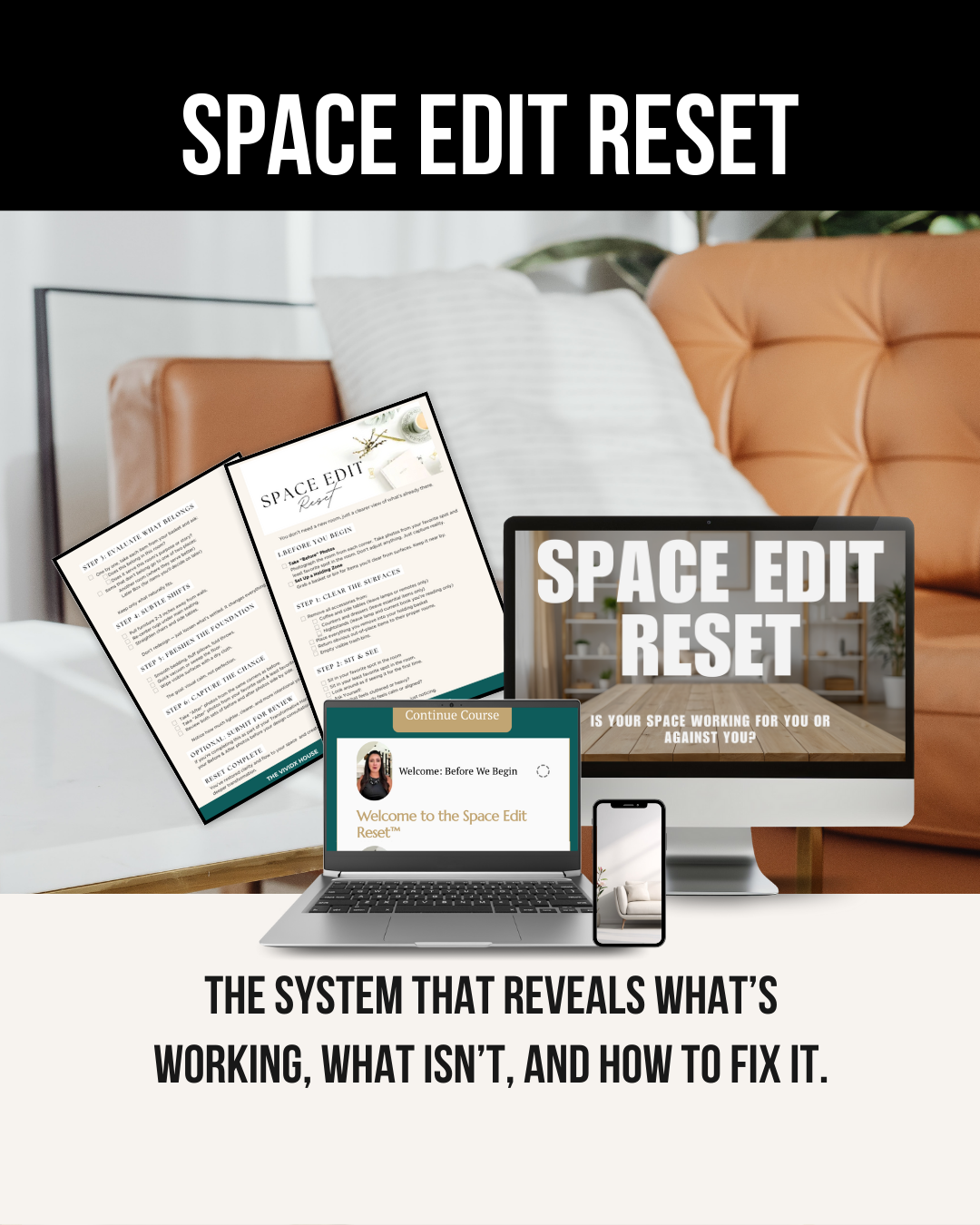
This is exactly what the Space Edit Reset™ teaches
The Space Edit Reset™ does not start with decor.
It starts with structure.
It teaches you how to read your room the way designers do, so arrangement stops being guesswork.
Inside the Reset, you learn how to:
• observe the room with fresh angles
• clear surfaces to expose the structure
• define the room’s purpose
• identify the true anchor
• place each item with intention
• rebuild the layout so it finally feels right
Once you learn the method, arranging a room becomes clear and repeatable.
Two moves that instantly improve any arrangement
1. Pull the anchor piece forward by two inches
Do not rearrange.
Just pull the sofa, bed, or table slightly forward.
This releases pressure from the walls and reveals the real shape of the room.
2. Remove everything from one wall and re enter the space
A blank wall exposes balance issues immediately.
You will see whether the layout feels grounded or crooked.
A real homeowner moment
A homeowner once told me she had arranged her living room five times and nothing felt right. Once we applied the real sequence, the issue became obvious.
Her sofa was aligned to the TV, but the architectural focal point was a large window on another wall. Every arrangement she tried felt wrong because she was anchoring the room to the wrong element.
We rotated the layout toward the true focal point.
She sat on the sofa and said, “This is the first time this room has ever made sense.”
Your next step
If arranging a room feels confusing or frustrating, the problem is not your eye for design. The problem is the missing sequence. A room that works is built on structure, not surface choices.
That is exactly what The Space Edit Reset™ teaches you.
Apply these principles inside The Space Edit Reset™.
Is your space working for you or against you?
JOIN THE FACEBOOK GROUP: The Space Edit Reset Group