
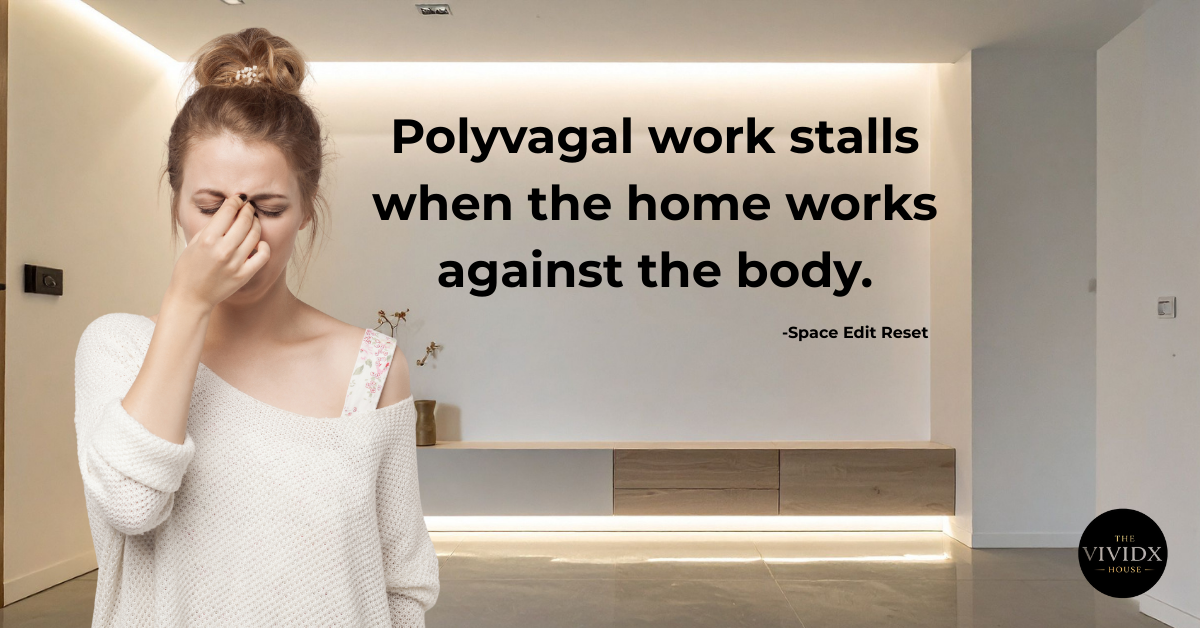
Why Polyvagal Work Often Stalls Without Environmental Support
Clients practicing polyvagal tools often describe inconsistent progress. They regulate well in certain environments and struggle the moment they return home. They do the exercises correctly. They understand the concepts intellectually. They try to apply the techniques throughout the day. Yet real-world results vary in a way that frustrates them.
From a design standpoint, that inconsistency is not a mystery.
The environment is either supporting regulation or competing with it.
A home influences the nervous system before the first conscious thought forms. It does not whisper. It directs. Clients step into a room and their system shifts based on the visual weight, the way the furniture compresses movement, the number of objects in their sightline, and the posture the room requires of them. The body registers all of this before they intentionally practice a single skill.
Polyvagal work assumes a foundation.
Most clients do not realize their home is shaping the foundation every minute they spend in it.
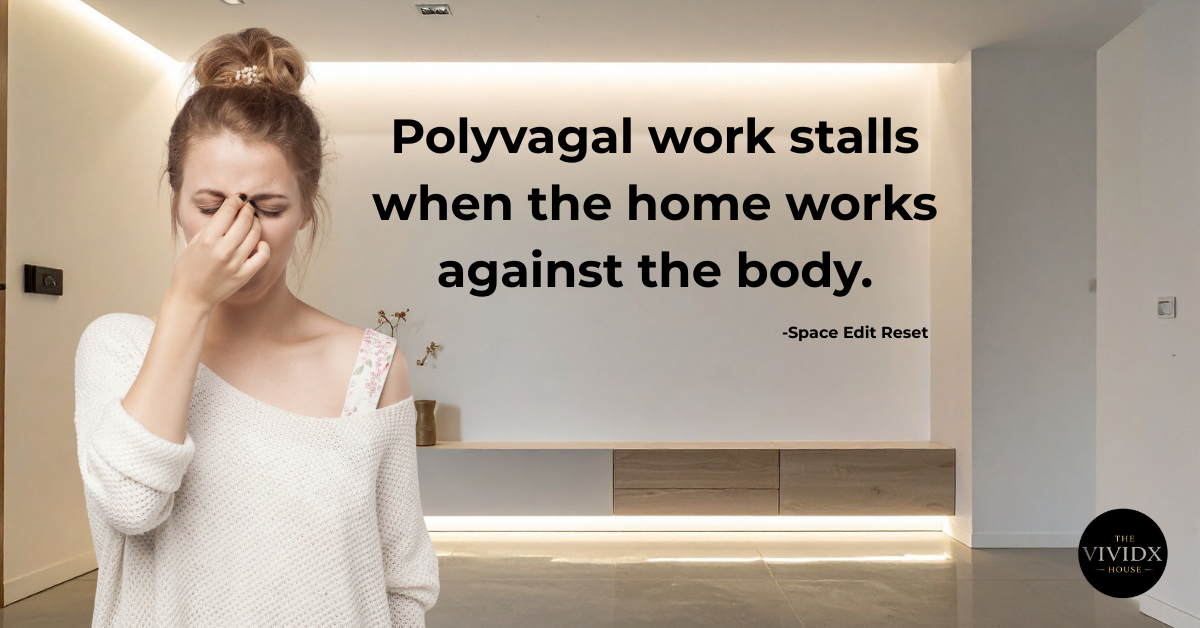
THE HOME AS A NERVOUS-SYSTEM INPUT
A room communicates through several channels:
1. Seating that alters posture and breath mechanics
A sofa that is too deep pulls the torso backward and forces the neck forward. A chair that is too low collapses the ribcage and reduces capacity. A dining chair placed at an angle that faces a walkway increases alertness. These positions become the “norm” in the home, and clients attempt regulation exercises while their body is fighting its own furniture.
2. Sightlines that send mixed signals
Clients often sit facing crowded bookshelves, multiple small decorative objects, or walls with competing artwork. Even if the items are beautiful, the system receives fragmented data. The eyes jump from one detail to another. The body prepares for sorting, scanning, and interpreting.
3. Circulation paths that require micro-adjustment
When clients have to turn sideways to pass between furniture, step around a corner that juts too far into the pathway, or weave between items on the floor, the system subtly lifts into problem-solving mode. Polyvagal practices lose effectiveness in an environment that keeps asking the body to adjust.
4. Surface activity that creates low-level strain
Counters or tables covered with small objects require processing. The system scans and categorizes even when the client does not consciously notice. They may sit down to practice a calming technique yet face a table filled with visual tasks.
These environmental inputs impact the same physiology that polyvagal work addresses.
When the environment contradicts the skill, progress slows.
WHY CLIENTS BLAME THEMSELVES INSTEAD OF THE ROOM
Clients often interpret the problem as a lack of discipline or skill:
“I’m trying, but it is not working.”
“I can do this in the therapist’s office but not at home.”
“I lose the effect as soon as I walk into my house.”
They assume the issue is internal.
Meanwhile, the room is pulling their system in a different direction.
A home with high visual load activates the same pathways polyvagal tools aim to stabilize. A room that compresses movement encourages protective tension. A layout that forces constant scanning keeps clients in low-level readiness.
They are not failing the technique.
Their environment is competing with it.
THE SPACE EDIT RESET™: THE ENVIRONMENTAL FOUNDATION POLYVAGAL WORK NEEDS
The Space Edit Reset™ addresses this gap without requiring clients to redesign the room or buy new furniture. It gives them a structure to stabilize their environment so their body can participate in regulation instead of resisting it.
The six-step sequence restores function, reduces friction, and builds an environment that cooperates with the client’s body.
It begins with clearing surfaces so the room is no longer visually competing for attention. This alone shifts the baseline load on the system.
Next, clients sit in different vantage points. This is one of the most revealing moments for those practicing polyvagal work. They suddenly notice what their system has been responding to every day:
a shelf directly in their sightline filled with varied heights
a walkway that narrows near the sofa
a table pushed too close to the wall
tall objects that tower over seating and create subconscious guarding
a desk that forces the body into a forward-leaning posture
a layout that orients the client toward the busiest visual plane in the room
When they observe the room through the lens of their nervous system, the environment’s influence becomes impossible to ignore.
Clients often say, “I did not realize the room was doing this to me.”
The next step, the emotional inventory, gives clients language. They name what feels supportive and what feels heavy. They describe what their body registers even when nothing looks objectively wrong. This is often the first time they understand how design and physiology intersect.
REAL EXAMPLES OF HOW ROOMS DISRUPT POLYVAGAL WORK
Example One: The home office that kept triggering activation
One client practiced vagal toning techniques daily. Yet she consistently described tension the moment she began working at her desk. When she went through the Reset steps, she discovered that her desk chair faced a surface filled with small objects. The items were visually neutral, but the density required her system to scan constantly.
After clearing the surface and shifting her chair by a few degrees, her body stopped responding with immediate tension. The technique she had been practicing began working for the first time at home, not just in controlled environments.
Example Two: The living room posture problem
Another client practiced grounding exercises but struggled to feel relaxed in her living room. Her sofa was deep, soft, and comfortable, but it forced her into a posture that compressed her core and curved her neck forward. Her system stayed in slight agitation because the furniture demanded a protective position.
Through the Reset, she discovered that simply adding a firm pillow to adjust her seating position changed her body’s response. Her polyvagal work stabilized because her posture no longer contradicted her practice.
Example Three: The kitchen that overwhelmed focus
Clients who spend significant time in the kitchen often describe losing the effects of their regulation tools the moment they enter the space. One client realized her kitchen counters held too many small appliances. The room demanded constant sorting from her eyes. She could regulate properly in other rooms but not here.
During the Reset, she cleared one counter at a time. The room became spacious, visually ordered, and less demanding. Her polyvagal practices stopped collapsing under environmental noise.
None of these changes required buying anything new.
They required seeing the room accurately.
The Space Edit Reset™ provided the structure for that awareness.
WHY POLYVAGAL WORK REQUIRES A SUPPORTIVE HOME BASELINE
Polyvagal work relies on repetition and consistency. Clients must practice in environments that reinforce the desired state rather than contradict it.
When the home environment supports regulation:
posture improves
breath expands
scanning decreases
tension drops
recovery speeds up
skills generalize more easily into daily life
When the environment works against regulation:
clients feel inconsistent
skills degrade faster
fatigue increases
emotional capacity decreases
progress feels unpredictable
Many clinicians focus on the body’s internal capacity. The Space Edit Reset™ focuses on the external conditions that shape that capacity.
The combination changes everything.
WHAT CLIENTS CAN DO THIS WEEK TO SUPPORT THEIR POLYVAGAL WORK
Here are foundational steps:
1. Clear the nearest surface in their most used room.
This reduces visual load and gives the system a place to rest.
2. Sit in three positions and note the first object their eyes land on.
This reveals the primary visual stressor in each position.
3. Adjust one seating posture using a pillow or firmer support.
Small posture changes create immediate nervous-system shifts.
4. Photograph the room from the four corners.
Photos expose the environmental cues clients overlook.
These steps support polyvagal techniques by reducing environmental contradiction.
The body stops fighting the room and begins responding to the skill.
THE ENVIRONMENT AS A PARTNER IN NERVOUS-SYSTEM TRAINING
Polyvagal theory shows how regulation depends on cues of safety, support, and orientation.
Design shows how a room quietly shapes each of those cues.
When the two disciplines work together, clients experience regulation as something their home supports, not something they must fight for.
A home can reinforce activation.
A home can neutralize activation.
A home can support regulation.
Design determines which one occurs.
The Space Edit Reset™ gives clients a clear, structured way to bring their home into alignment with the work they do in your office.
Is their space working for them or against them?