
How to Decorate When You Don’t Know Your Style
You want a beautiful home. You know what you like when you see it, but when you try to decorate your own space, everything feels random. You scroll through inspiration, but nothing seems consistent. You buy pieces you love, but they do not look right together. You try to define your style, but it feels slippery, inconsistent, or impossible to put into words.
If you have ever thought, “I don’t know my style,” you are not stuck. You are simply decorating without a structure. Style becomes clear only after the foundation is correct.
Not knowing your style is not a problem. It is a signal.
Most people blame themselves for lacking style, but the issue is never about taste.
The issue is that the room has no defined purpose, no clear anchor, no balanced sightlines, and no structural clarity.
Without structure, every style feels confusing.
With structure, your style becomes obvious.
Here is why you cannot identify your style yet
You are trying to define your style while:
• the layout is off
• the scale is mismatched
• the anchor is wrong
• the room is carrying too much weight
• the space is reflecting an older version of your life
Style cannot emerge from a disorganized foundation.
It emerges from clarity.
1. Your room is talking over your decor
A room with structural issues will overpower any decor you add.
You could have beautiful pieces, but if the room is unaligned, the style feels inconsistent.
This is why people think they “do not have a style.”
Their style never had space to appear.
2. You are mixing purchases without understanding the anchor
When you buy decor before identifying the anchor, the pieces have nothing to respond to.
They float around the room without a relationship to each other.
Your style shows up only when everything in the room reflects the same anchor.
3. You are looking at inspiration before observing your own space
Scrolling through inspiration can feel helpful, but it becomes confusing when you do not yet understand what your room needs.
You have been trying to choose a look.
You need to choose a structure first.
4. Your identity has shifted but your space has not
Many people “lose their style” when their life changes.
Your space still reflects an older version of you, so everything new feels disconnected.
You do not lack style.
You have outgrown the space.
Style becomes clear when the structure is right
Designers do not start with style.
They start with:
• layout
• proportions
• sightlines
• circulation
• anchor
• purpose
Once the structure is set, style becomes extremely easy to identify.
Homeowners always say the same thing once the reset is complete:
“I finally know what I like.”
This is exactly why the Space Edit Reset™ works
The Space Edit Reset™ reveals your style by stripping away visual noise and aligning the foundation of the room.
Inside the Reset, you learn how to:
• observe the room with fresh eyes
• clear the surfaces blocking your style
• define what the space is actually for
• identify the correct anchor
• balance visual weight
• rebuild the room so your preferences finally make sense
Once the structure is correct, your style becomes visible and consistent.
Two moves that help you discover your style today
1. Clear one entire surface and leave it empty for a full day
When a surface is empty, you can see the true architecture of the room.
This clarity reveals the direction your style naturally leans toward.
2. Sit in three spots and write one word for each
The words you choose reveal your style more accurately than any mood board.
Most people discover they want:
• softer lines
• stronger contrast
• more texture
• fewer items
• larger scale pieces
• lighter walls
Your body knows what it wants before your mind does.
A real homeowner moment
A homeowner once told me she had “no style at all.” She kept buying items she liked, but everything felt mismatched once she put them together.
Once we worked through the Reset, her style became obvious within minutes.
Her anchor had been wrong for years.
Her sofa was centered to the TV instead of the architecture.
Every item she bought felt wrong because the structure was wrong.
We aligned the anchor and cleared her sightline.
Suddenly all her previous purchases looked cohesive.
She said, “I do have a style. My room was blocking it.”
Your next step
If you feel like you do not know your style, the issue is not your taste. It is the structure. The Space Edit Reset™ teaches you how to build a foundation where your style finally becomes clear, consistent, and grounded.
Apply these principles inside The Space Edit Reset™.
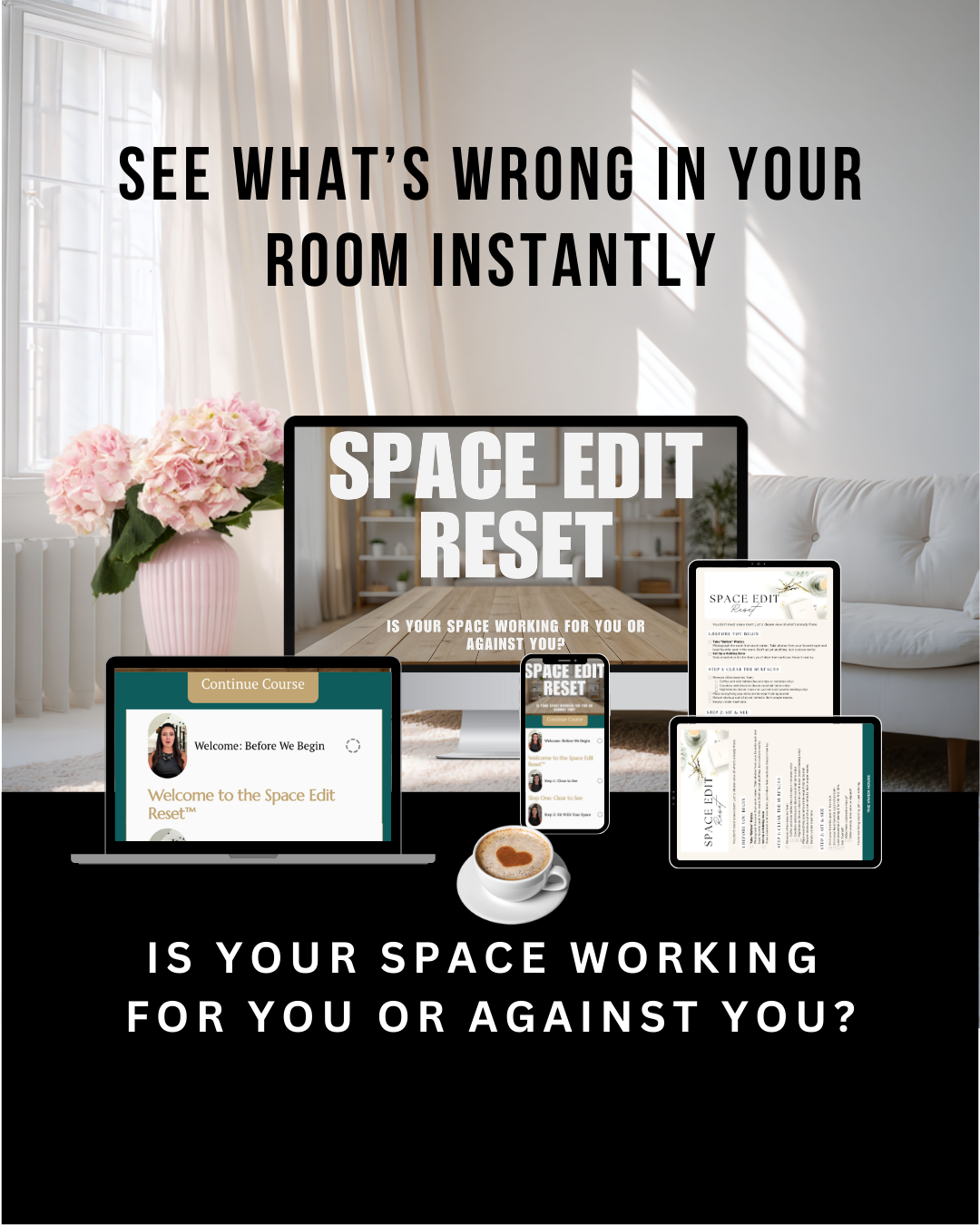
Is your space working for you or against you?
JOIN THE FACEBOOK GROUP: The Space Edit Reset Group
Why Does My Furniture Look Great Online but Terrible in My House
You scroll through beautiful photos, pick a piece you love, and imagine how perfect it will look in your home. It arrives, you set it up, and immediately something feels wrong. The furniture is pretty. The style matches your taste. But in your home it looks awkward, oversized, underwhelming, or completely disconnected.
This experience frustrates homeowners everywhere.
You start doubting your taste. You wonder if you chose the wrong piece. You question whether you are “bad at decorating.”
But the issue is not your taste. The issue is the gap between online staging and real life structure.
Furniture that looks perfect online often clashes with the architecture of your home
Retail photos and staged rooms are carefully designed to make each piece look ideal.
These spaces have:
• higher ceilings
• wider walkways
• balanced lighting
• large-scale rugs
• perfectly centered focal points
Your home has different proportions, different circulation, and different visual weight.
When scale and structure do not match, even a beautiful piece feels out of place.
Here are the real reasons the furniture feels wrong
Once you understand what is happening, the problem becomes clear and fixable.
1. The scale was staged for a larger room
Online photos hide scale issues by placing furniture in oversized spaces.
A sofa that looks delicate online may feel bulky in your living room.
A coffee table that looks substantial online may feel tiny at home.
Scale is the most common reason furniture fails in real life.
2. The piece was centered to a perfect anchor you do not have
Retail staging aligns furniture to:
• large windows
• high arches
• fireplaces
• long symmetrical walls
If your room lacks that clear anchor, the piece has nothing to align itself to.
It looks lost even though it looked perfect online.
3. Your walkway is tighter than the staged layout
Online rooms have wide, generous walkways.
Most homes do not.
A chair that looks airy online can squeeze circulation in real life.
A table that looks minimal online can block your path at home.
Your body picks up the friction immediately.
4. The visual weight shifts the moment it enters your space
A piece may have looked balanced online because the surrounding furniture absorbed the weight.
In your home, the piece may suddenly feel too heavy or too light depending on what is around it.
Rooms feel wrong when visual weight is not balanced.
5. The function of your room does not match the function of the staged room
Staged spaces are designed to look good in a photo.
Your room is designed to be lived in.
If the staged purpose does not match your lifestyle, the piece never feels like it belongs.
Why swapping pieces never solves the real issue
You buy something new.
It arrives.
It feels wrong again.
You swap it for another piece.
It still feels wrong.
This cycle continues because the problem is not the furniture.
The problem is the missing structural step.
This is exactly why the Space Edit Reset™ works
The Space Edit Reset™ teaches you how to read your room before you bring anything new into it.
It shows you how to:
• see the true scale of your space
• identify the correct anchor wall
• understand the natural walkway
• balance visual weight
• choose pieces that work with the architecture, not against it
Once you apply the system, furniture that once felt wrong suddenly makes sense.
Two moves to reveal why the piece looks wrong
1. Pull the piece forward and check the sightline
Most furniture looks wrong because it is pressed too tightly to the wall.
Move it forward two inches.
Look again.
This reveals whether the real issue is scale or placement.
2. Take a photo from the lowest corner of the room
This camera angle exposes imbalance instantly.
You will see whether the piece is too tall, too small, or pulling the room out of alignment.
A real homeowner moment
A homeowner once bought a beautiful accent chair that looked perfect online. In her living room, it looked wrong no matter where she placed it. The style was right. The color was right. But the feeling was off.
Once we applied the Reset sequence, the issue became obvious.
The chair was scaled for a room with higher ceilings and wider walkways.
In her space, it disrupted the flow and pulled the room forward visually.
We adjusted the layout, identified the true anchor wall, and shifted the seating zone slightly.
The chair finally made sense.
She said, “It was never the chair. It was the room.”
Your next step
If furniture looks great online but terrible in your home, the issue is not the piece. It is the structure it entered. The Space Edit Reset™ shows you exactly how to read your room so you choose pieces that work with your home instead of fighting it.
Apply these principles inside The Space Edit Reset™.
Is your space working for you or against you?
JOIN THE FACEBOOK GROUP: The Space Edit Reset Group